
DrivePulse re-ran its detection algorithm across all 26 platforms covered by the GM ignition switch recall campaigns. Across 22 platforms with ignition-related signal, the system identified 44 events — 80 percent of which predated the first recall announcement by a median of six and a half years. The median detection date among pre-recall events was 2,370 days — roughly six and a half years — before February 2014. The earliest detection occurred in January 2001, more than thirteen years before the recall.
In a recent post, we described three improvements to DrivePulse's core detection algorithms — changes to event merging, vehicle generation handling, and a new detector for rapidly accelerating complaint volumes. As part of that writeup, the Pontiac Grand Am appeared briefly as a case study: its electrical system signal illustrated how the old 365-day merge rule had incorrectly collapsed two distinct detected events into one.
That mention prompted us to do what we should have done earlier — give the GM ignition switch case a proper treatment with the current database. This post does that.
Between 2014 and 2015, General Motors issued eight separate recall campaigns covering nearly 29 million vehicles worldwide. The underlying defect was the same across all of them: ignition switches installed in a range of GM platforms — in some cases as early as model year 1997, per NHTSA recall campaign 14V400000, which covered 1997–2003 Chevrolet Malibu models among others — had insufficient rotational torque. Under vibration — from a heavy keychain, road conditions, or incidental contact with the driver's knee — the switches could slip from the "Run" position to "Accessory." When that happened, the engine shut off. Power steering and power brakes degraded. And, most critically, the airbag system was disabled at the moment it was most needed.
The defect was not obscure. Internal GM records indicate that engineers and legal staff were aware of the problem by at least 2005. The first recall was not announced until February 6, 2014 — nearly a decade later. The initial recall covered the Chevrolet Cobalt and Pontiac G5; subsequent campaigns through September 2015 extended to more than two dozen additional platforms across Chevrolet, Pontiac, Saturn, Oldsmobile, Cadillac, and Buick.
The final tally of the GM Ignition Switch Compensation Fund confirmed 124 deaths directly attributable to the defect. In September 2015, GM entered into a deferred prosecution agreement with the Department of Justice, forfeiting $900 million. A separate victim compensation fund paid approximately $600 million.
We ran DrivePulse's detection algorithm across the platforms and components covered by the eight recall campaigns, looking for events consistent with the ignition switch defect in the electrical system component. The analysis used NHTSA complaint data only — no forum data was available or used for these platforms.
Across 22 platforms where ignition-related events were detected, the system identified 44 events. Of these, 35 — 80 percent — had a start date before the first recall announcement on February 7, 2014.
The earliest detection occurred on January 21, 2001, for the Chevrolet Monte Carlo (2000–2009 generation): 4,765 days, or more than thirteen years, before the recall. The Saturn Ion (2003–2008), which was among the vehicles in the initial recall, was first flagged in February 2004 — a ten-year lead. The Chevrolet Cobalt (2005–2012), the platform most prominently associated with the defect, first appeared in DrivePulse's database in February 2006, nearly eight years before the recall.
The median detection date among pre-recall events was 2,370 days — roughly six and a half years — before February 2014.
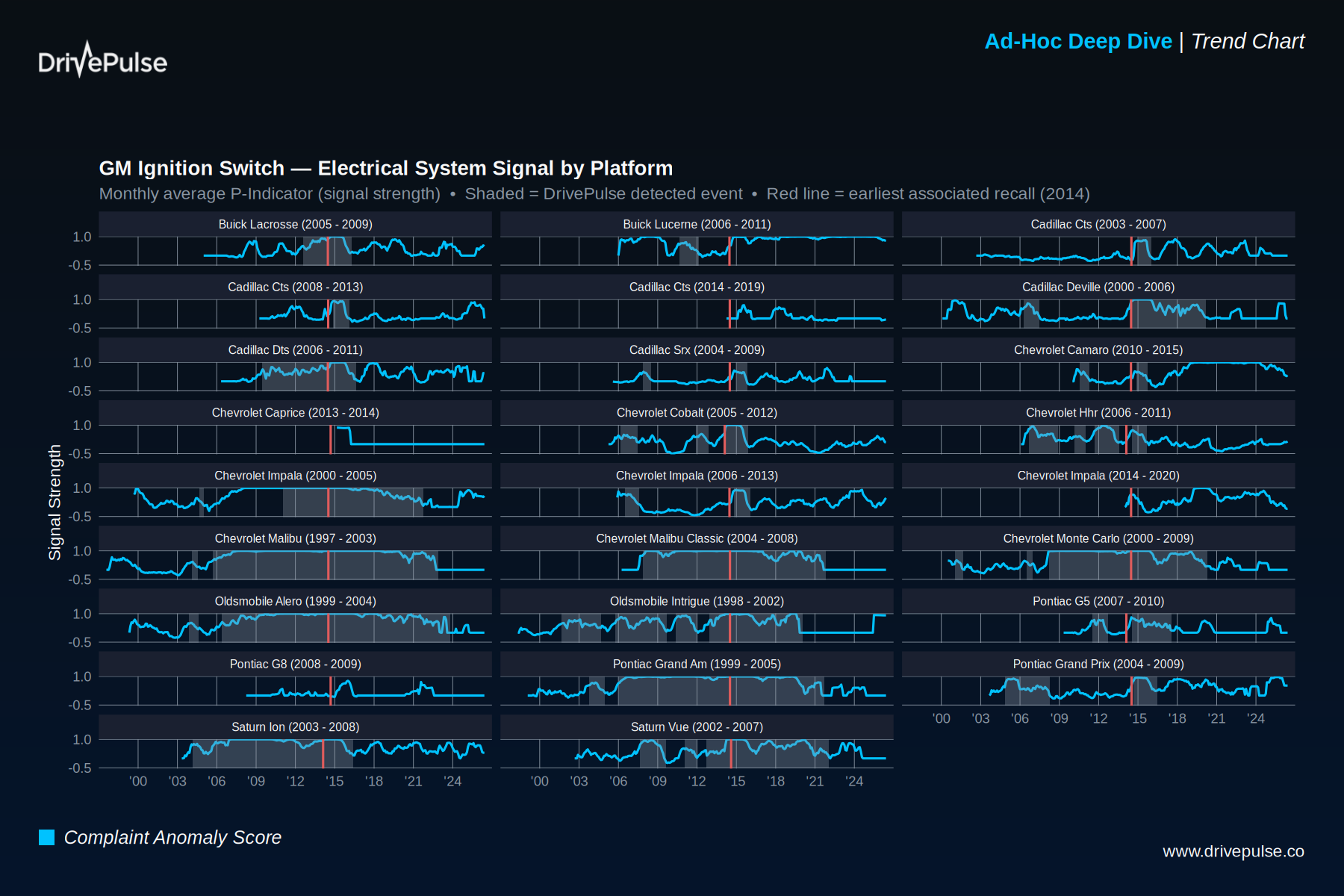
The chart shows a consistent pattern across most platforms: complaint-driven signal emerged well before any regulatory action and in many cases sustained for years before cresting or declining. The Cobalt, Ion, and Grand Am panels each show multi-year elevated signal through the mid-2000s. On several platforms — Oldsmobile Intrigue, Oldsmobile Alero, Chevrolet Malibu — the signal had already run its course and subsided before the recall was announced, reflecting the age of the affected model years.
Four platforms in the chart are marked with †, indicating no ignition-related event was detected. Two of these — the Pontiac G8 (2008–2009) and the Cadillac CTS (2014–2019) — are covered by the recall campaigns but generated no DrivePulse event matching the ignition switch defect signature in the electrical system component. For the G8, the system detected events in other component categories (powertrain, airbag, suspension) reflecting separate complaint streams unrelated to the switch-slip defect. For the CTS (2014–2019), the most relevant electrical system event describes starter motor failures in the 2014 model year — a different failure mode than the low-torque switch. The Chevrolet Caprice (2013–2014) and Chevrolet Impala (2014–2020) are included because a single model year from each (2014) falls within the recall scope; neither generated ignition-related complaint signal at the scale needed for detection.
We include these panels in the chart as a straightforward accounting of the recall scope. Not every platform produced a detectable signal. That is the expected result of a statistical system working on sparse data at the tail of a platform's production run.
For seven of the 44 events, the complaint summaries are more ambiguous. The stalling and power-loss symptoms are consistent with the ignition switch defect, and the platforms are covered by the recall campaigns. However, the event descriptions don't explicitly mention key-stuck incidents, PASSLOCK system failures, or engine shutdown on bumps — the signatures most directly associated with the defect.
These seven events are:
We include these in the count as consistent with the defect but note that they cannot be linked to the switch-slip mechanism with the same confidence as the other 37 events.
The numbers above describe what was present in the complaint data and what DrivePulse's algorithm would have surfaced. They do not imply that complaint signal alone is sufficient to determine root cause, establish a safety defect, or compel a recall. NHTSA and manufacturer engineering teams perform extensive investigation — teardown analysis, field returns, statistical correlation with crash data — before a recall is appropriate.
DrivePulse provides early signal. The interpretation and response are the domain of the engineers and regulators who receive it.
What the data does suggest is that complaint-based monitoring could have directed attention toward these platforms much earlier. Whether earlier attention would have altered the timeline of the recall, and whether a different timeline would have reduced harm, is a question for regulators and historians, not for this analysis.