
This week's Weekly Pulse: four early complaint signals worth watching — a fast-accumulating engine failure pattern on the 2024 Chevy Trax, continued downshift complaints on 2013 F-150s tied to an open NHTSA investigation, a two-track defect cluster on the 2016 Ford Fusion, and a design change on the 2026 Model Y removing a manual frunk-release backup. None of these are recalls yet.
DrivePulse detects defect events across passenger vehicles, commercial platforms, tires, and automated driving systems. The following represent the most notable patterns in recent NHTSA complaint data — early signals that may or may not develop into formal recalls. None of the events below constitute a safety determination; they represent statistical anomalies in consumer complaint patterns that may warrant attention from safety and quality teams.
────────────────────────────────────────
Affected Model Years: 2024
Complaints: 36 over 46 days
First Detected: 2026-06-08 | Status: Active
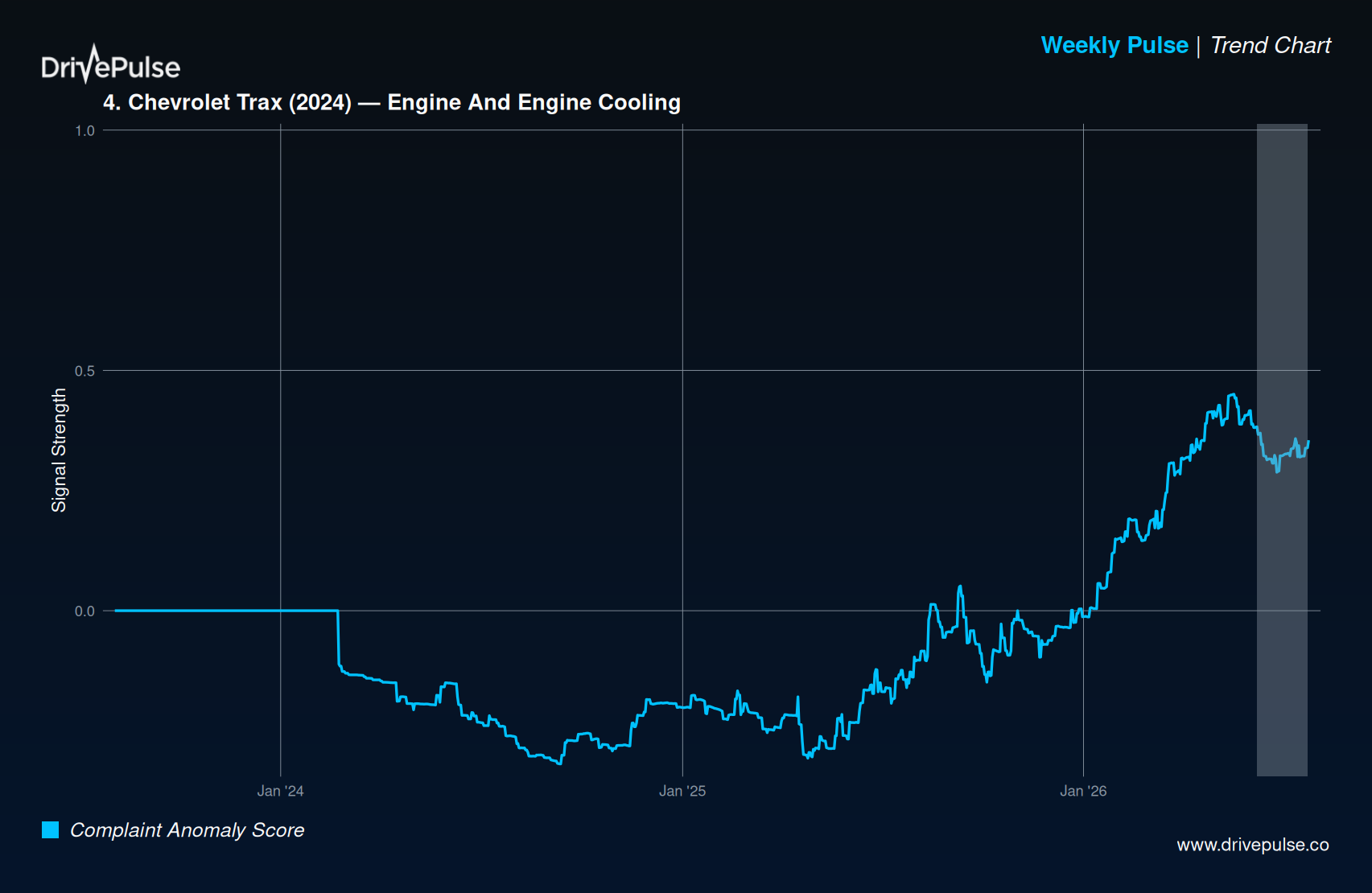
What We're Seeing: Owners describe catastrophic engine failures from internal rod or bearing breakage and turbocharger failure, resulting in oil loss and engine seizure, sometimes accompanied by loud noises, smoke, or complete loss of power at highway speed.
In the News: A pending class-action lawsuit alleges GM's inline-three engine in the Trax and related models is prone to catastrophic failure, citing loss of acceleration and steering assistance as an "acute and unreasonable" safety risk; the litigation does not identify confirmed injuries.
Why It Matters: The data shows a first-model-year engine failure pattern accumulating quickly (36 complaints in under two months), which is relevant to quality teams assessing early-production engine durability.
────────────────────────────────────────
Affected Model Years: 2013
Complaints: 31 over 52 days
First Detected: 2026-06-03 | Status: Active
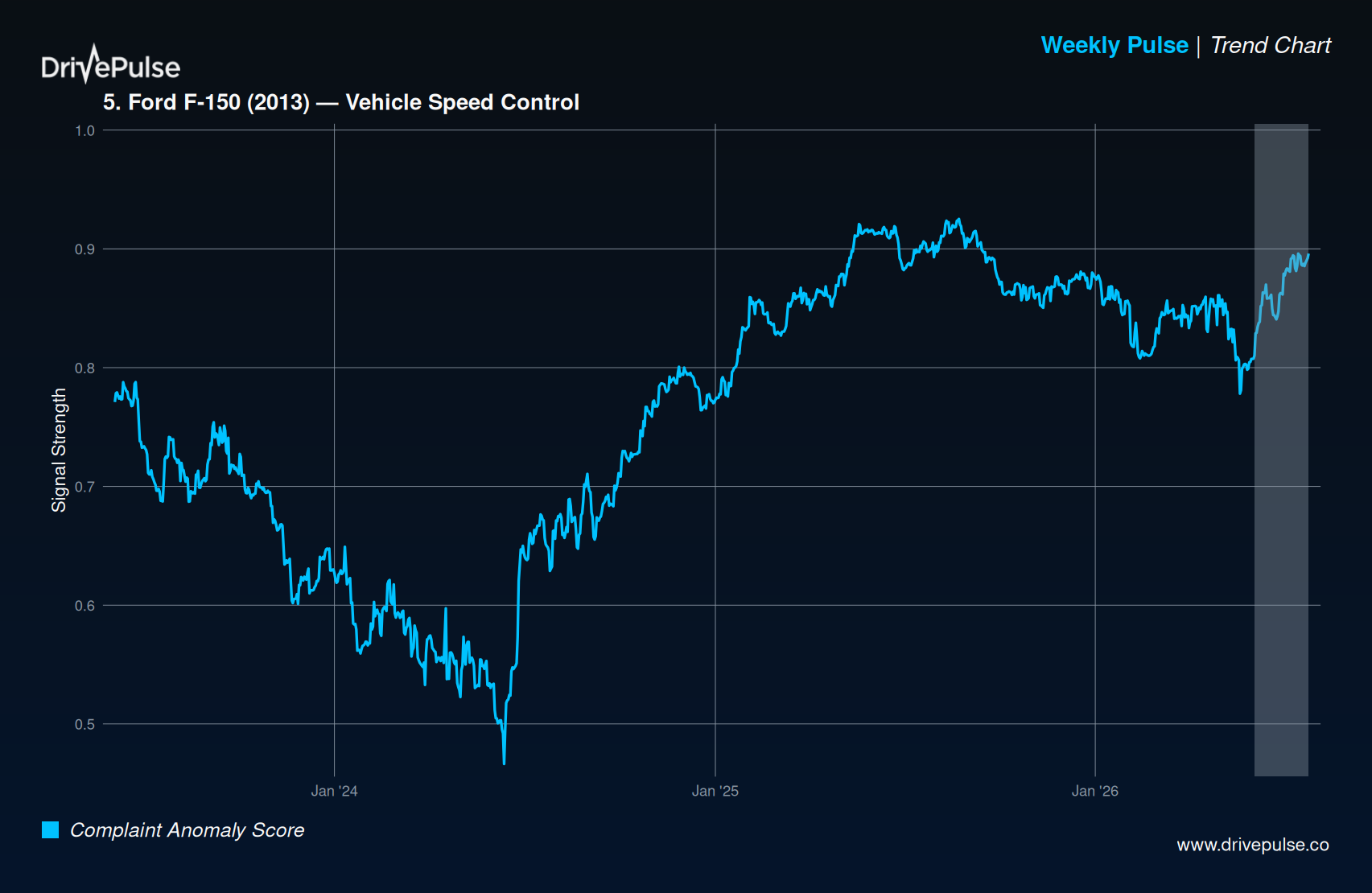
What We're Seeing: Owners describe the 6R80 transmission suddenly and unexpectedly downshifting to a low gear at highway speed, producing rear-wheel lockup, dashboard failures, and loss of vehicle control.
In the News: Ford has separately recalled roughly 1.4 million F-150s for related 6R80 unexpected-downshift defects tied to electrical connector wear, and NHTSA has an open investigation into sudden transmission downshifts on the platform. Ford has told regulators it is aware of two injuries and one accident potentially caused by this defect.
Why It Matters: The data shows a documented downshift failure mode, already the subject of a federal investigation and prior recall on related model years, continuing to generate complaints on the 2013 model year specifically.
────────────────────────────────────────
Affected Model Years: 2016
Complaints: 36 over 22 days
First Detected: 2026-07-03 | Status: Active
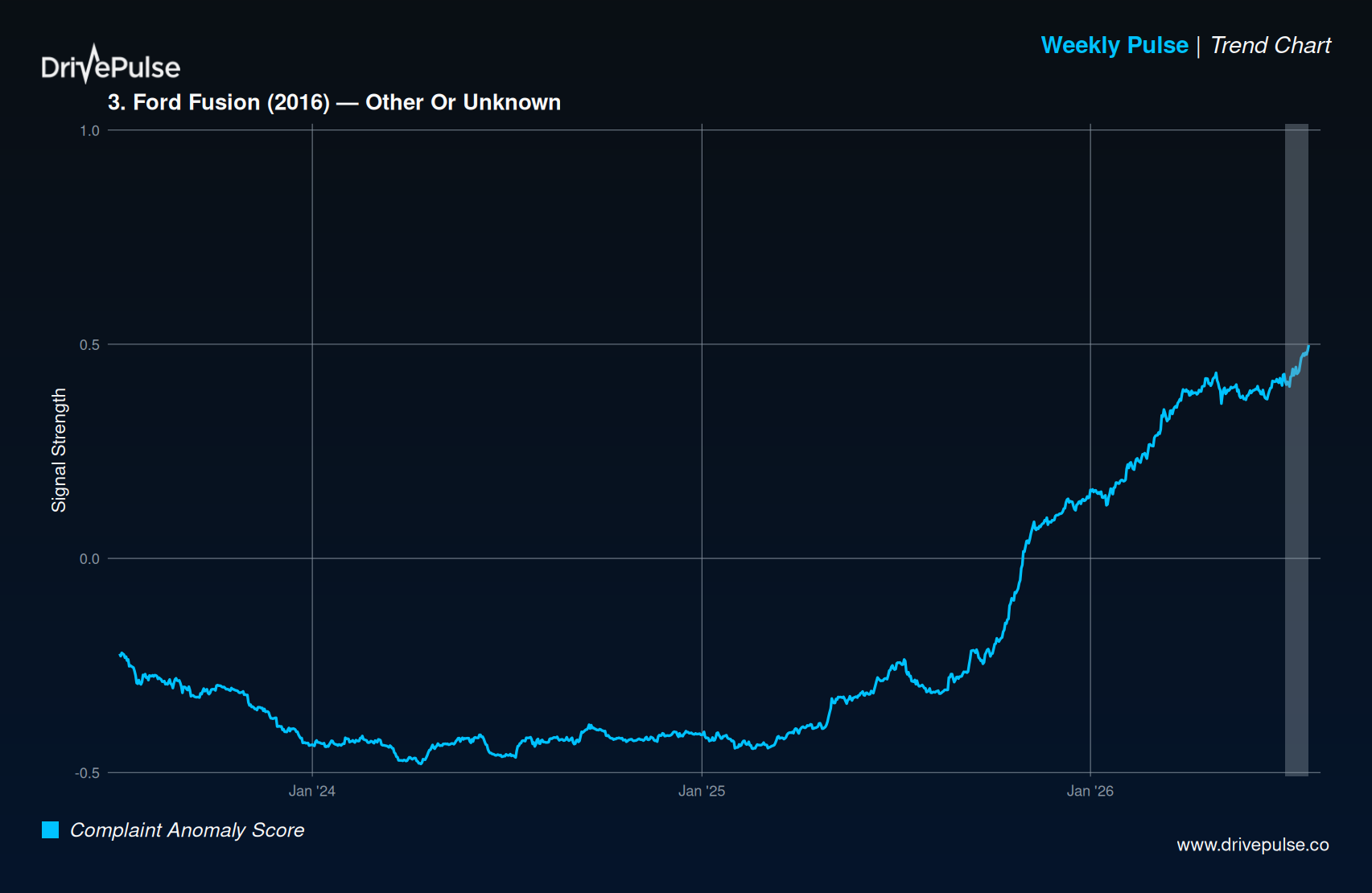
What We're Seeing: Owners report repeated backup-camera failures (black screens, distortion) alongside a separate pattern of 1.5L EcoBoost head-gasket and turbo drain-tube leaks that produce overheating and white smoke.
In the News: Ford's backup-camera defects across multiple model years resulted in a 2024 federal penalty of $165 million; Ford has reported crashes tied to camera failures on affected platforms but no injuries. This specific 2016 Fusion cluster has not drawn dedicated press coverage.
Why It Matters: The data shows two unrelated defect patterns — a visibility aid and a powertrain cooling fault — accumulating concurrently on the same platform, relevant to teams tracking multiple independent failure modes on a single vehicle line.
────────────────────────────────────────
Affected Model Years: 2026
Complaints: 22 over 19 days
First Detected: 2026-07-05 | Status: Active
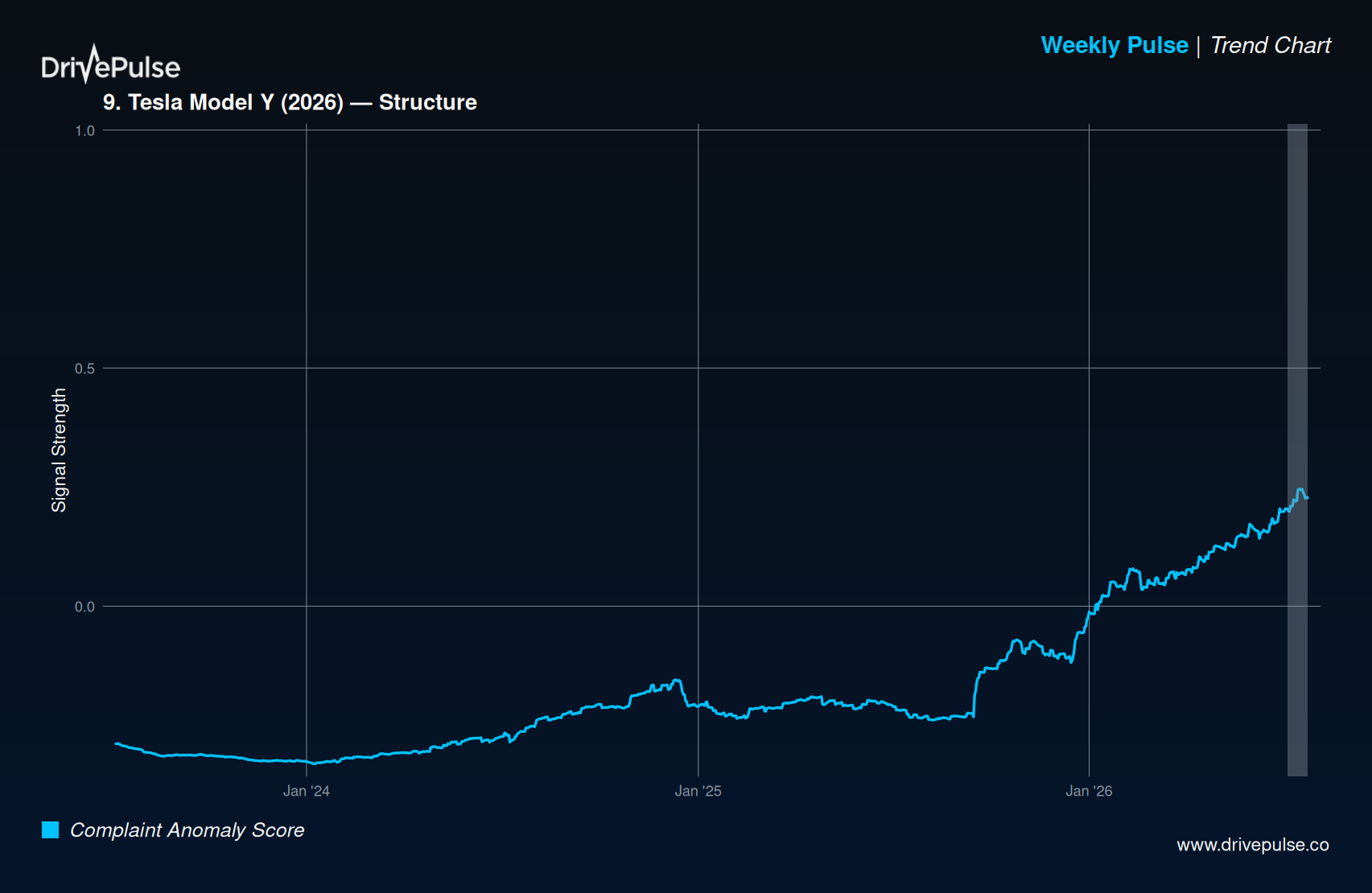
What We're Seeing: Owners report that recent Model Y units are missing the interior front-trunk emergency release button and its indicator light, a design change complainants say does not provide a manual means to exit the frunk from inside if the powered release fails.
In the News: Complainants and press coverage frame this as a Federal Motor Vehicle Safety Standard 401 compliance question, since that standard requires an interior release mechanism for enclosed compartments to prevent entrapment. This specific frunk-release change is separate from — but shares a root concern with — other documented incidents in which occupants have been unable to exit Tesla vehicles through powered door releases during a fire, including fatalities under investigation and litigation in unrelated crash incidents.
Why It Matters: The data shows a design change removing a manual backup for a powered-release mechanism, which is directly relevant to how vehicle architects balance powered convenience features against non-powered fallback paths for occupant egress.
────────────────────────────────────────
Data sourced from the NHTSA complaints database, current through 2026-07-22.
Statistical detection by DrivePulse.
DrivePulse | drivepulse.co