
Eight active signals this week, including a persistent ICCU failure pattern recurring across both Hyundai and Kia after their respective recalls, a high-volume Honda Accord head-gasket cluster (441 complaints in five months), and a distinct Toyota Camry UA80 transmission signature. Plus: a well-documented Prius V brake-actuator defect still generating complaints more than a decade after the affected model year.
DrivePulse detects defect events across passenger vehicles, commercial platforms, tires, and automated driving systems. The following represent the most notable patterns in recent NHTSA complaint data — early signals that may or may not develop into formal recalls. None of the events below constitute a safety determination; they represent statistical anomalies in consumer complaint patterns that may warrant attention from safety and quality teams.
────────────────────────────────────────
Affected Model Years: 2013, 2014, 2015, 2016, 2017, 2018
Complaints: 12 over 20 days
First Detected: 2026-06-27 | Status: New Detection
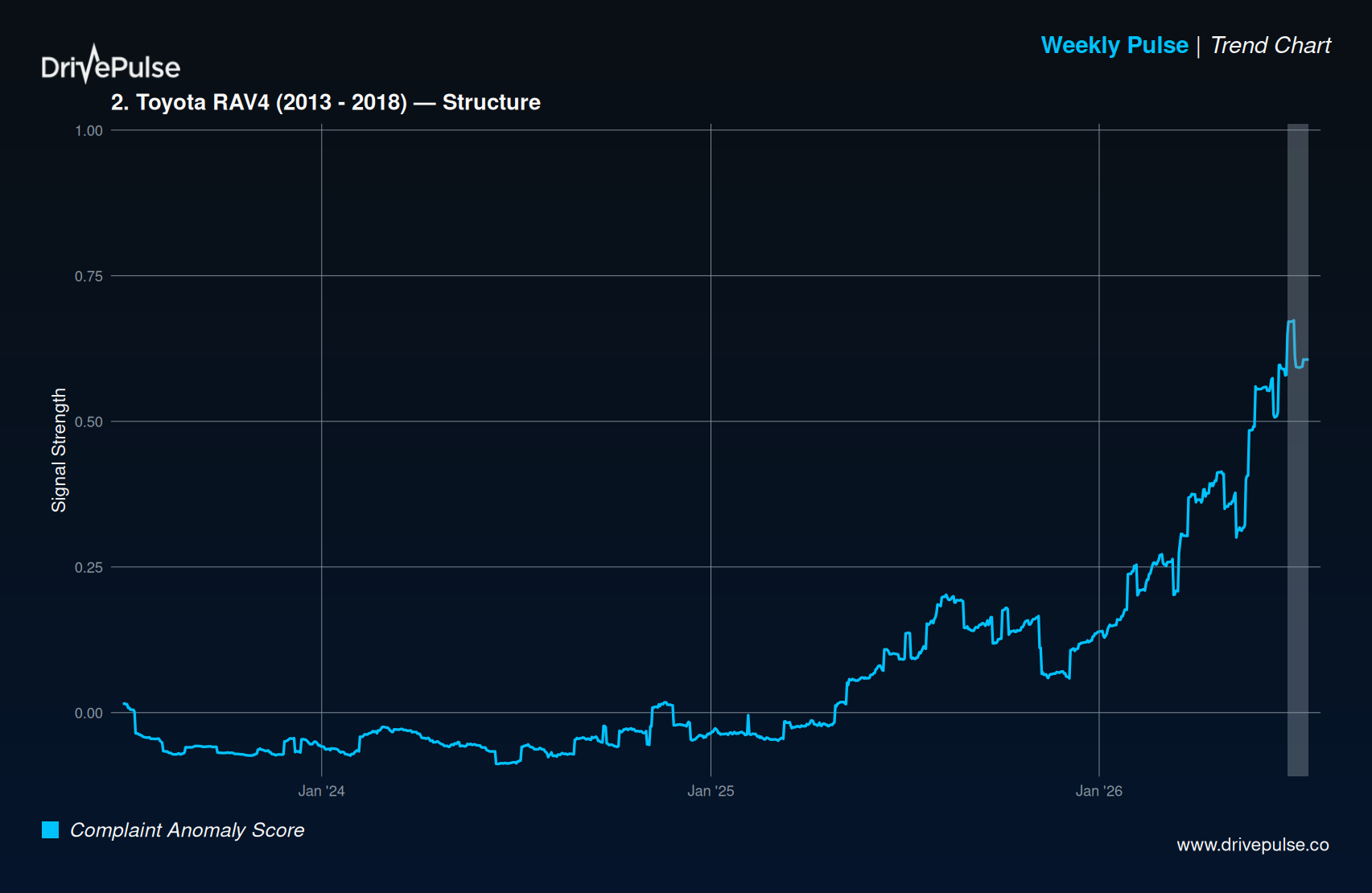
What We're Seeing: Complaints describe premature paint delamination on roof and hood panels exposing bare metal to corrosion, alongside chronic water intrusion at the cabin pillars and cowl that owners say recurs even after dealer service. A smaller set of reports also cites liftgate hinge misalignment.
In the News: Paint delamination on 2013-model-year RAV4s in specific color finishes has been documented in owner forums and a Toyota technical service bulletin (T-SB-0162-19) addressing peeling paint on metal body panels; no recall currently covers this pattern.
Why It Matters: Water intrusion at pillar and cowl locations raises questions about long-term corrosion and electrical component exposure that are relevant to quality and durability assessments independent of any single safety event.
────────────────────────────────────────
Affected Model Years: 2019
Complaints: 12 over 54 days
First Detected: 2026-05-24 | Status: Updated
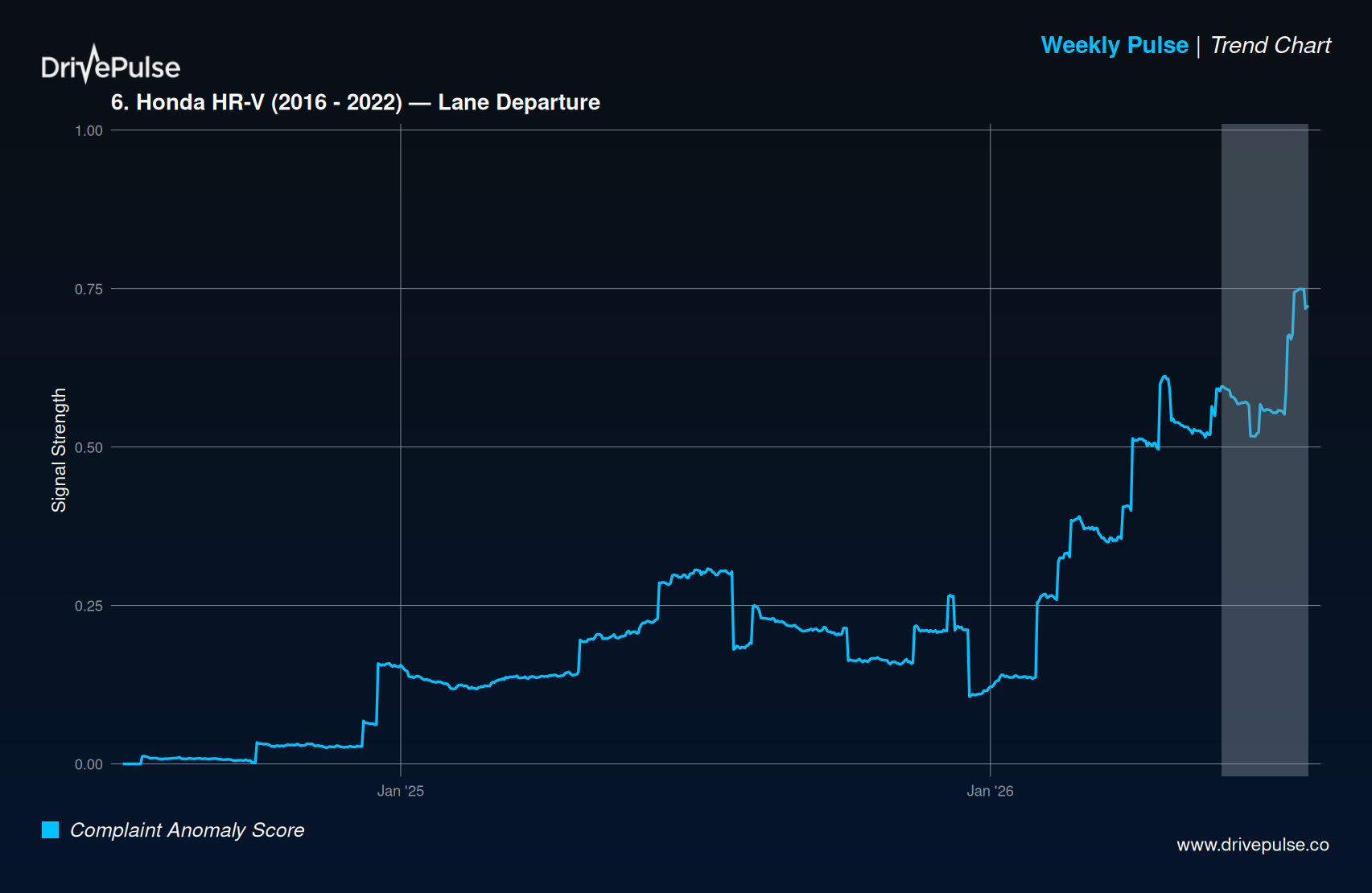
What We're Seeing: Complaints describe the front multipurpose camera failing (DTC U3000-49), which disables lane-keeping, adaptive cruise, collision warning, and automatic high-beam functions simultaneously. A smaller set of reports notes steering-linkage looseness that owners associate with lane-assist operation.
In the News: NHTSA has an active, broader investigation into a "sticky steering wheel" defect across more than 532,000 Honda vehicles including the HR-V, which some complainants also reference in connection with lane-assist behavior; that investigation includes reports of crashes.
Why It Matters: A single camera fault disabling multiple independent driver-assistance features at once is relevant to how ADAS systems are architected for graceful degradation rather than full shutdown.
────────────────────────────────────────
Affected Model Years: 2020, 2021
Complaints: 26 over 73 days
First Detected: 2026-05-05 | Status: Updated
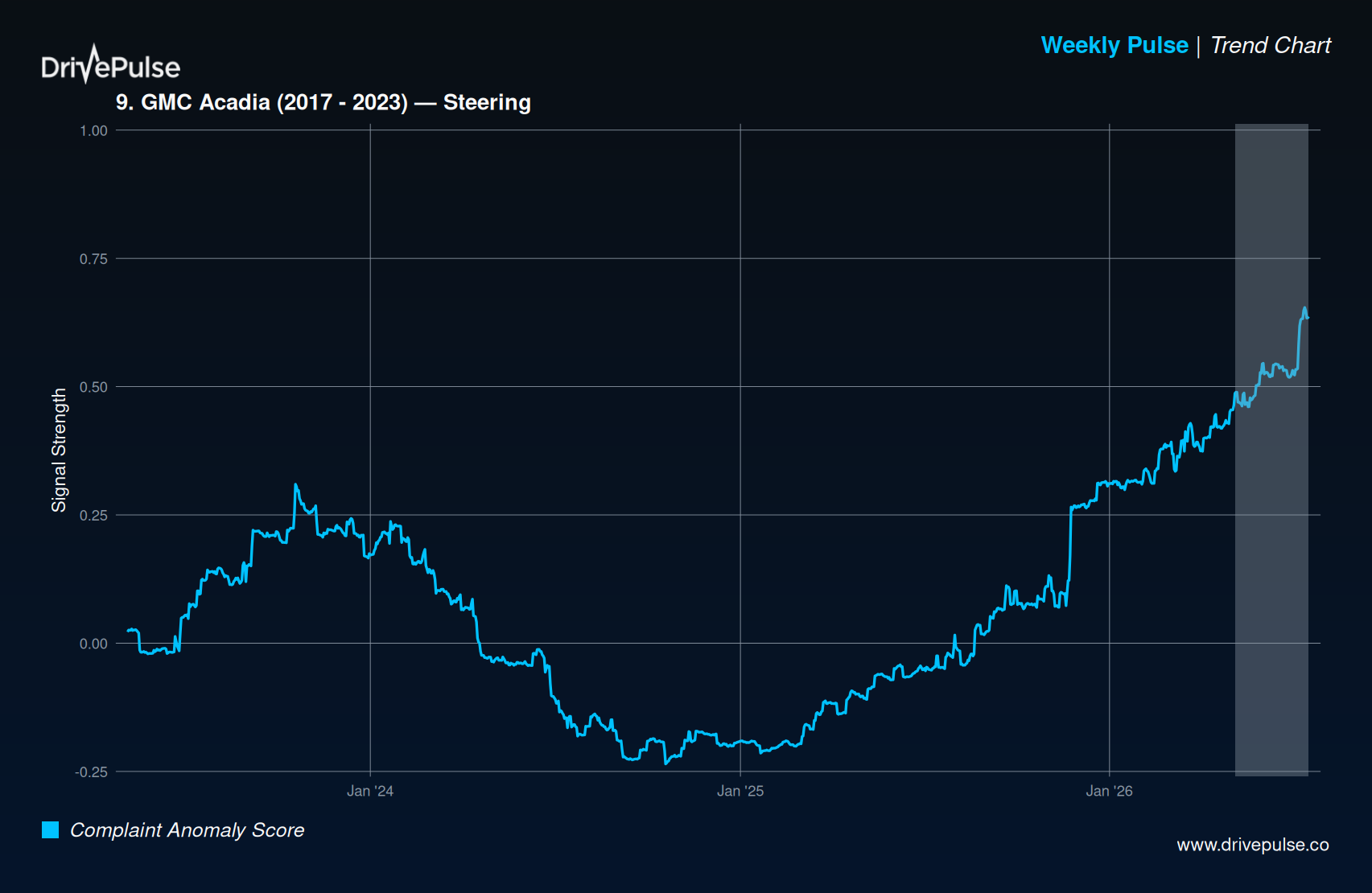
What We're Seeing: Complaints describe a "Steering Assist Reduced — Drive with Care" dashboard message that, per the underlying reports, originates from a faulty coolant thermostat or temperature sensor rather than a mechanical steering defect — the vehicle's logic reduces steering assist when it misreads an overheating condition. A related pattern shows the cooling fan continuing to run for 10-20 minutes after shutdown.
In the News: This behavior is documented in a GM technical service bulletin and widely discussed in owner forums; it is not currently the subject of an open recall. One owner account describes losing steering assist mid-turn onto a busy road.
Why It Matters: This event is filed under "Steering" in the complaint taxonomy, but the underlying reports point to a cooling-system sensor fault that cascades into a steering-assist warning — worth noting for teams triaging by complaint category, since the root cause here is not the steering system itself.
────────────────────────────────────────
Affected Model Years: 2018, 2019
Complaints: 441 over 148 days
First Detected: 2026-02-19 | Status: Updated
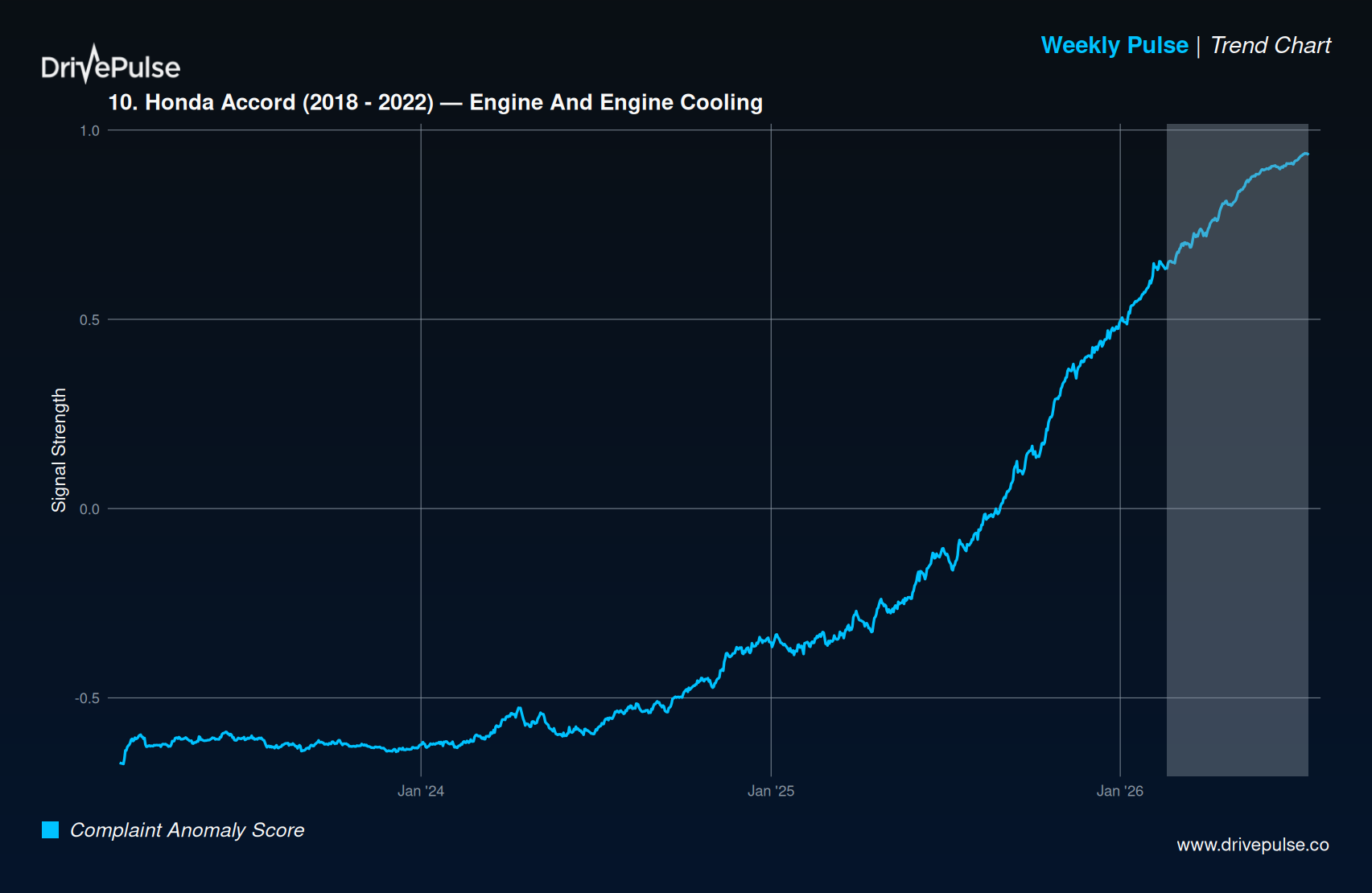
What We're Seeing: A large and sustained volume of complaints describes premature head-gasket failure on the 1.5L turbocharged engine, producing coolant loss without visible external leaks, misfires, and in some cases the engine entering limp mode. Complainants frequently cite under-torqued head bolts as a suspected contributing factor.
In the News: A class-action lawsuit filed in December 2024 alleges a coolant-leakage defect affecting 2016-2022 Honda vehicles with this engine family and cites elevated crash risk from sudden power loss; the litigation does not identify confirmed deaths or injuries.
Why It Matters: At 441 complaints over roughly five months, this is among the highest-volume signals DrivePulse is currently tracking on any platform, and the consistency of the failure description (head-gasket, coolant intrusion, limp mode) across reports points to a single, well-defined mechanical pattern rather than a mixed bag of symptoms.
────────────────────────────────────────
Affected Model Years: 2018, 2019
Complaints: 103 over 116 days
First Detected: 2026-03-23 | Status: Updated
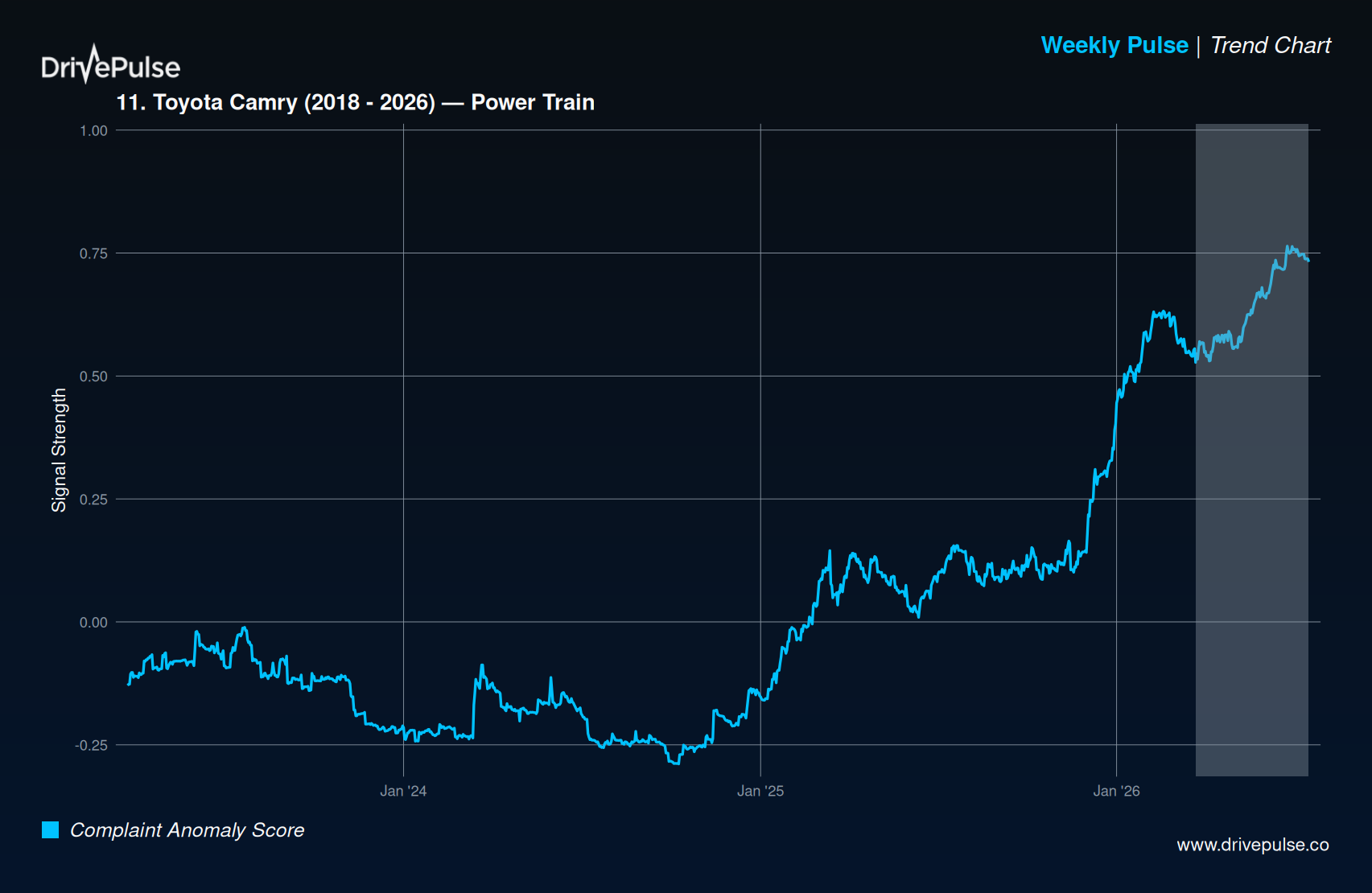
What We're Seeing: Complaints describe the UA80 eight-speed automatic transmission failing prematurely, with a distinctive whining noise, harsh or delayed shifting, and in advanced cases complete loss of drive with darkened, metal-flecked transmission fluid.
In the News: Toyota faces multiple class-action filings (December 2025, February 2026) alleging a design defect in the UA80 transmission across several Toyota and Lexus models; over 430 NHTSA complaints have been publicly tied to the platform. No confirmed deaths or injuries have been identified in connection with the transmission defect itself.
Why It Matters: The complaint volume and consistency of symptom description here — a specific whining noise preceding failure — gives quality teams a fairly precise early-warning signature to monitor ahead of any formal recall determination.
────────────────────────────────────────
Affected Model Years: 2023, 2024, 2025
Complaints: 13 over 67 days
First Detected: 2026-05-11 | Status: Updated
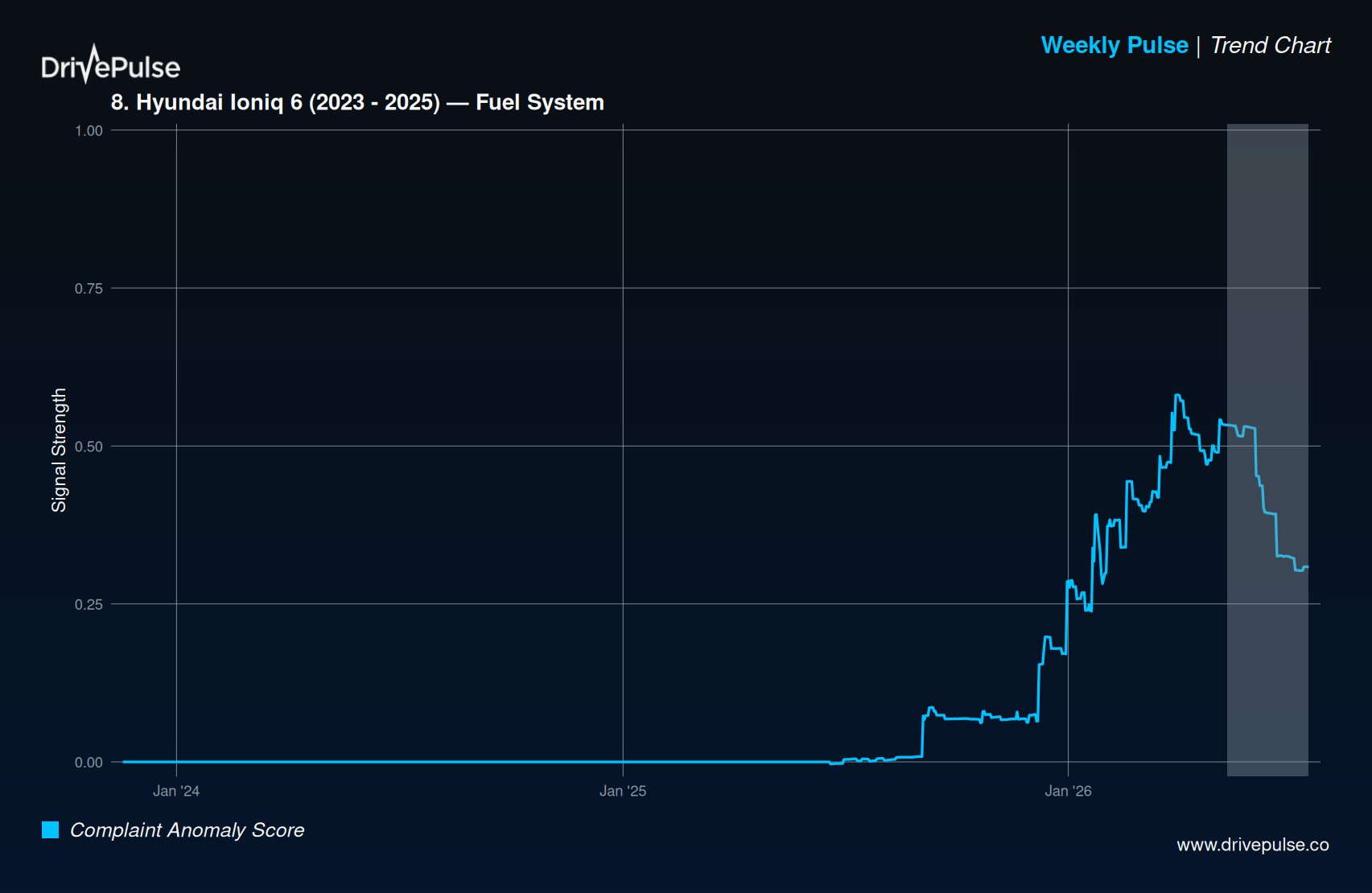
What We're Seeing: Owners report the Integrated Charging Control Unit failing, producing an audible pop, a "check electrical system" warning, an immediate speed reduction, and in some cases complete loss of drive power. A smaller set of complaints describes the charge-port door failing to open.
In the News: Hyundai issued Safety Recall 272 for the ICCU defect on 2023-2025 Ioniq 6 vehicles. In its recall filing, Hyundai states it is not aware of any confirmed crashes, injuries, or fires tied to the condition in the U.S. or Canada as of the filing date; a federal class action was subsequently filed in April 2026 alleging replacement units carry the same underlying defect.
Why It Matters: This week's complaints continue after the recall was issued, which is relevant to assessing whether the recall remedy is fully resolving the reported failure mode.
────────────────────────────────────────
Affected Model Years: 2022, 2023
Complaints: 49 over 140 days
First Detected: 2026-02-27 | Status: Updated
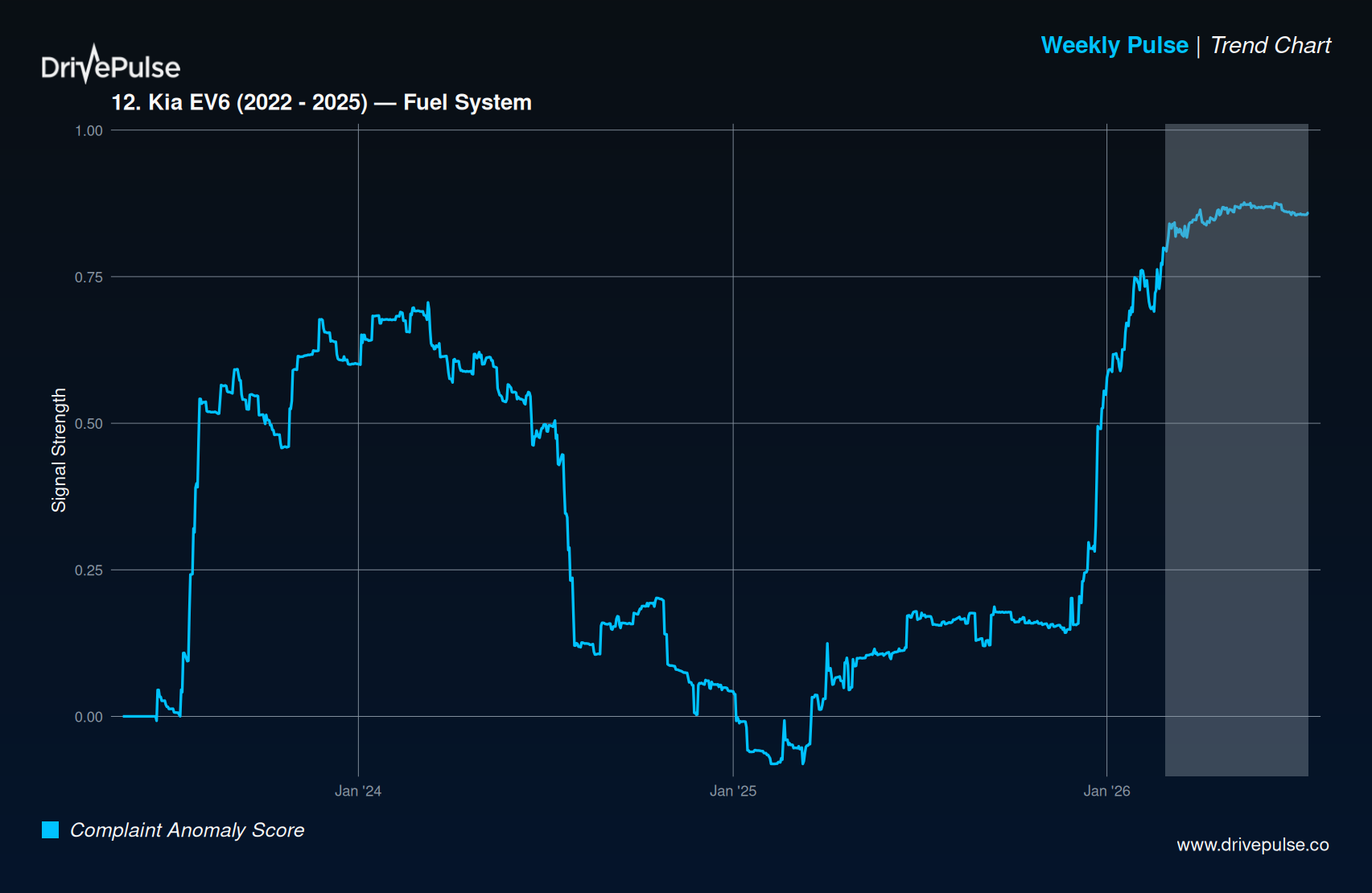
What We're Seeing: As with the related Ioniq 6 pattern above, owners describe Integrated Charging Control Unit failures producing an audible pop, immediate speed limitation to 20-25 mph, 12-volt battery drain, and interrupted AC charging.
In the News: Kia's recall addresses the ICCU defect on 2022-2024 EV6 vehicles. NHTSA's preliminary evaluation (PE23-012) initially recorded zero injuries and zero fatalities, though subsequent reporting describes at least one incident involving an injury connected to unexpected emergency braking during an ICCU-related power-loss event.
Why It Matters: This is the second ICCU-related event in this week's post, on a related Hyundai Motor Group platform sharing the same component supplier — a pattern worth tracking across the corporate family rather than model by model.
────────────────────────────────────────
Affected Model Years: 2013
Complaints: 25 over 108 days
First Detected: 2026-03-31 | Status: Updated
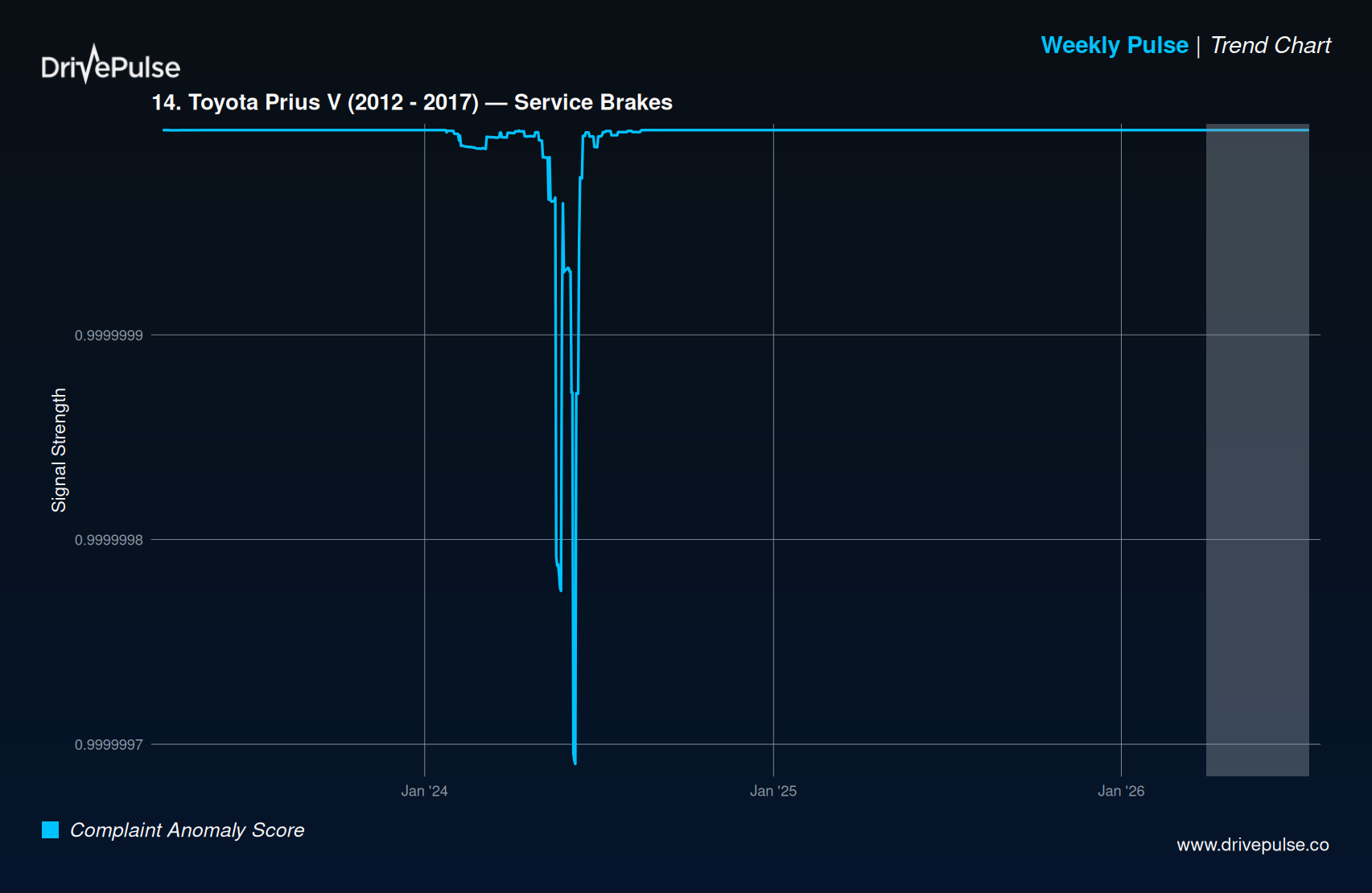
What We're Seeing: Complaints describe brake-actuator and booster-pump assembly failures (diagnostic codes C1391/C1392) that illuminate ABS, traction-control, and brake warning lights together and produce a spongy or unresponsive brake pedal, consistent with nitrogen gas from the booster pump leaking into the brake fluid and reducing hydraulic pressure.
In the News: This defect has been the subject of a 2020 NHTSA petition for investigation (DP19-004) and a class-action lawsuit covering Prius, Camry, and Avalon hybrid models. Reporting on the underlying defect describes at least 117 related complaints with roughly 60 alleging resulting crashes, including one documented 2013 Prius incident in North Hollywood, CA in which a driver was unable to stop the vehicle and struck three pedestrians in a crosswalk.
Why It Matters: This is a well-documented brake-system defect with an established history of crash-linked complaints predating this week's data; the continued complaint volume on 2013 model-year vehicles outside typical warranty coverage is relevant to assessing whether the underlying hardware issue remains unresolved in the existing vehicle population.
────────────────────────────────────────
DrivePulse | drivepulse.co