
This week's signals: coolant loss on the GMC Canyon tied to an open NHTSA investigation, a door-handle failure trapping Toyota Tacoma occupants inside the cabin, unannounced loss of all-wheel-drive on the Acura MDX, uncommanded braking on the Honda CR-V, and a shared-component pattern linking propulsion loss on the Chevrolet Volt and battery drain on the Chevrolet Trailblazer.
DrivePulse detects defect events across passenger vehicles, commercial platforms, tires, and automated driving systems. The following represent the most notable patterns in recent NHTSA complaint data — early signals that may or may not develop into formal recalls. None of the events below constitute a safety determination; they represent statistical anomalies in consumer complaint patterns that may warrant attention from safety and quality teams.
────────────────────────────────────────
Affected Model Years: 2024
Complaints: 11 over 10 days
First Detected: 2026-06-30 | Status: New Detection
Event ID: a44ba4c7098767b9
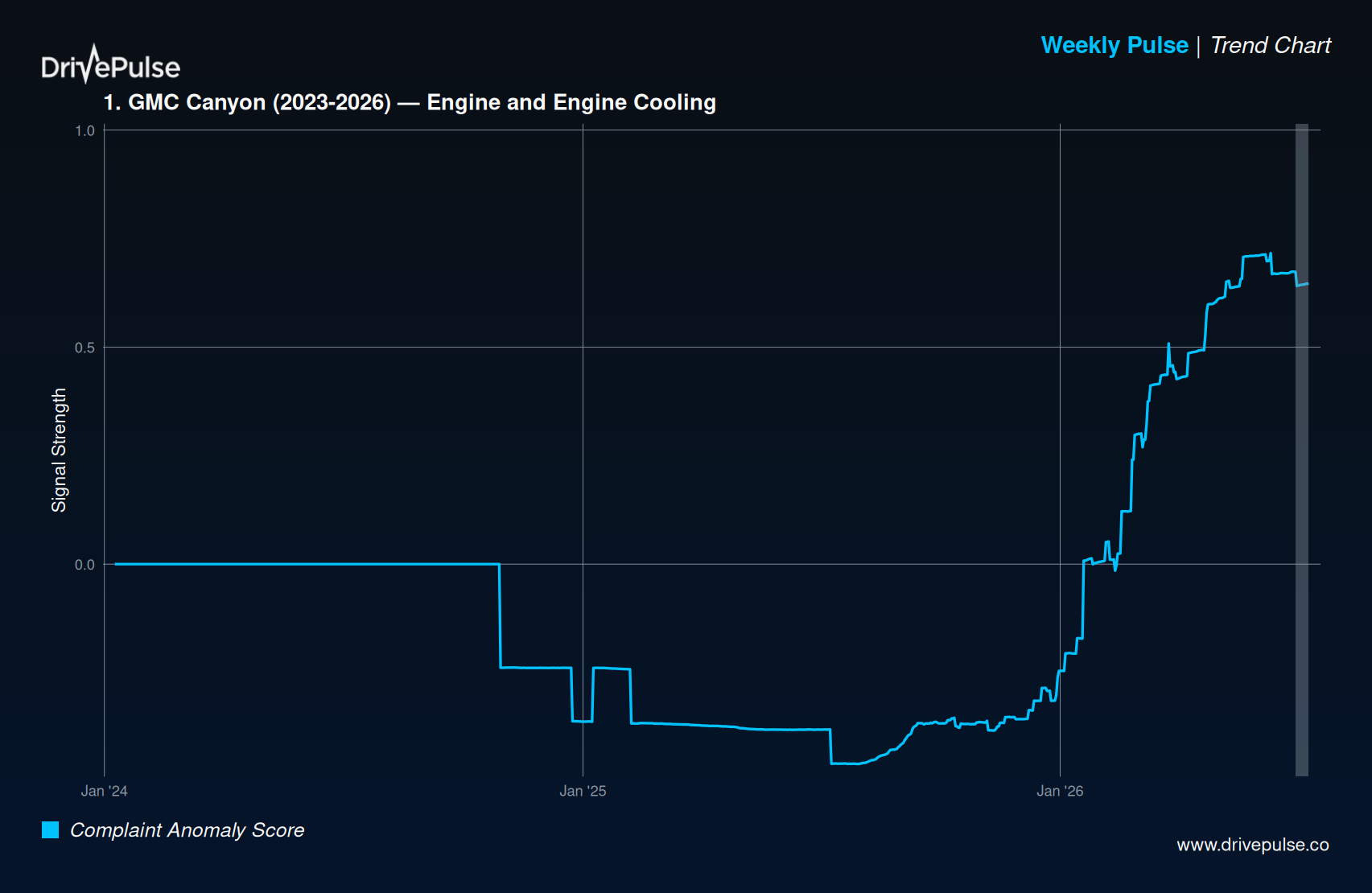
What We're Seeing: Owners report recurring coolant loss traced to the upper radiator hose O-ring, which produces low-coolant conditions and delayed overheating warnings. A subset of complaints separately describe power loss or stalling accompanied by a check-engine light, and a steering-shaft rattle that recurs after repair.
In the News: No mainstream press coverage found. NHTSA has an open technical investigation (PE25001, opened May 2025) into the coolant/O-ring issue, and GM has issued technical service bulletins but no recall to date.
Why It Matters: The complaint pattern — thermal-system failure paired with an open NHTSA investigation and no recall — is consistent with an early-stage signal ahead of formal action, relevant to both GM's quality and safety teams monitoring this platform.
────────────────────────────────────────
Affected Model Years: 2025
Complaints: 13 over 12 days
First Detected: 2026-06-28 | Status: New Detection
Event ID: c65f5dfd320bdd61
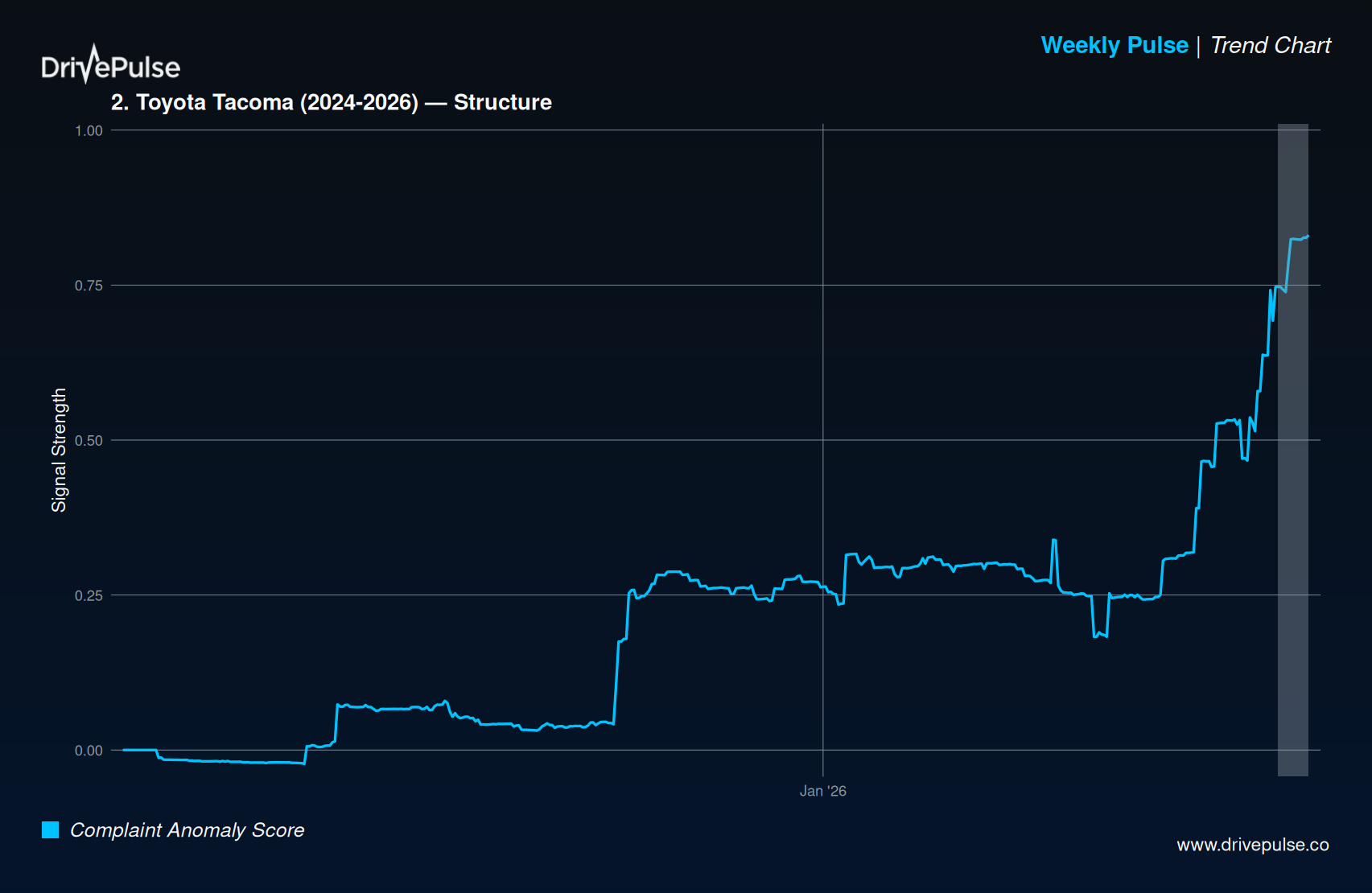
What We're Seeing: Multiple owners describe the interior door-handle mechanism failing at low mileage (roughly 6,000–9,000 miles), leaving the door inoperable from inside the cabin. Replacement parts are reported as back-ordered nationwide.
In the News: No mainstream press coverage found — reporting so far is limited to owner forums and a small number of aggregator sites. One complaint describes a driver needing to exit through the window after the handle failed. No recall has been issued for this component; a separate, unrelated driveshaft-joint recall exists for the 2025 Tacoma.
Why It Matters: An interior door mechanism that fails to open from inside is relevant to occupant-egress considerations, particularly given the parts back-order reported by owners; this is an early complaint cluster with no current recall or repair remedy.
────────────────────────────────────────
Affected Model Years: 2022
Complaints: 49 over 13 days
First Detected: 2026-06-27 | Status: New Detection
Event ID: d0f4aaa5d63e6757
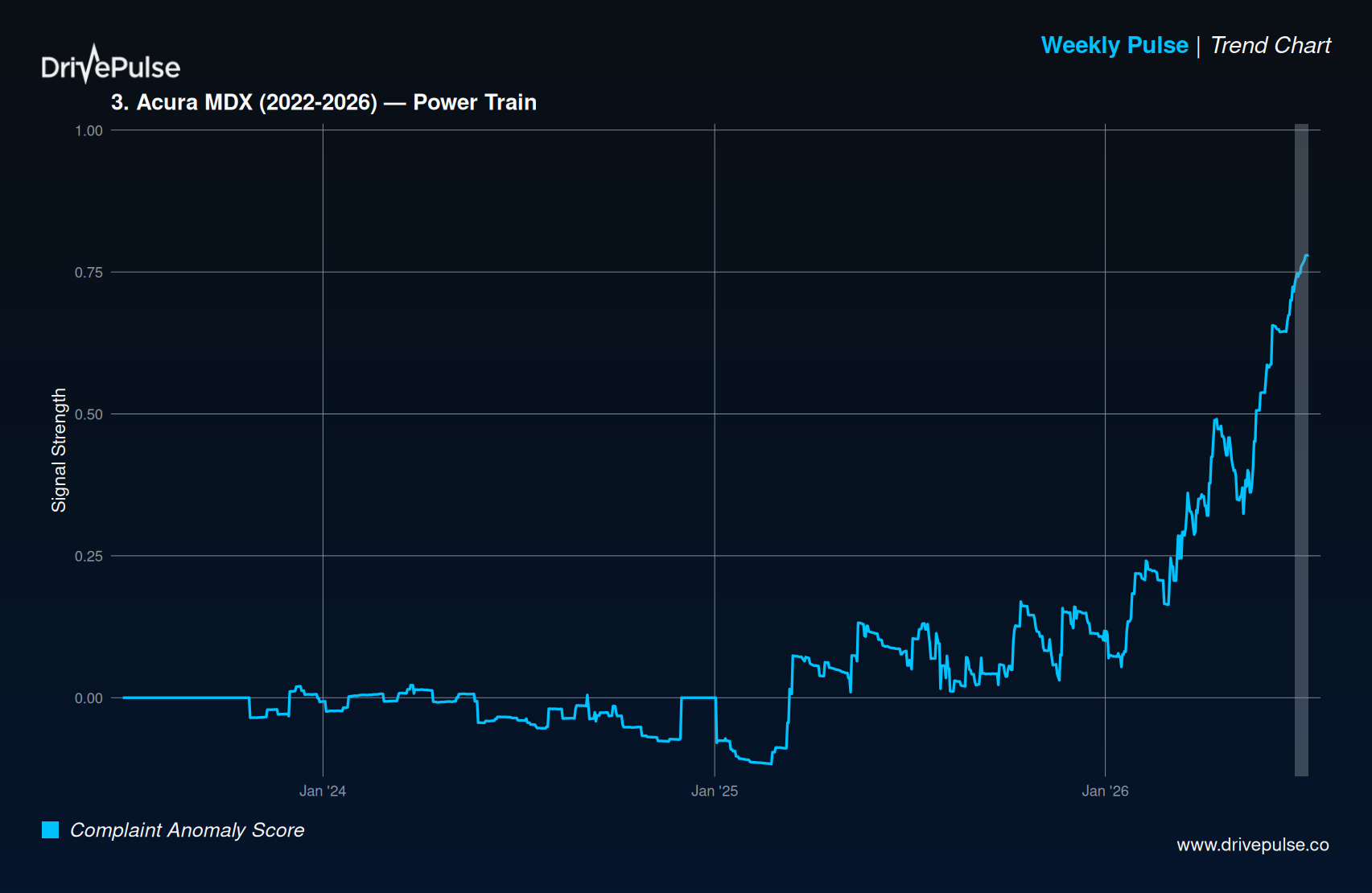
What We're Seeing: Owners describe a mechanical failure at the transfer-case/ transmission spline interface that causes the vehicle to revert to front-wheel-drive- only operation without any warning light or fault code, sometimes preceded by a loud clunk or torque-steer sensation.
In the News: This pattern has drawn coverage from several automotive outlets following NHTSA's opening of a formal investigation (DP26001) into roughly 137,000 2021–2023 Acura TLX and 2022–2023 MDX vehicles for transfer-case spline shearing. No crashes or injuries have been reported to NHTSA as of the most recent update. No recall has been issued.
Why It Matters: An unannounced loss of all-wheel-drive capability is most relevant in low-traction conditions; the existence of an active NHTSA investigation alongside this week's complaint volume gives safety and quality teams independent confirmation that the pattern is under regulatory review.
────────────────────────────────────────
Affected Model Years: 2025
Complaints: 25 over 38 days
First Detected: 2026-06-02 | Status: Updated
Event ID: 7e5691d27eb08cf3
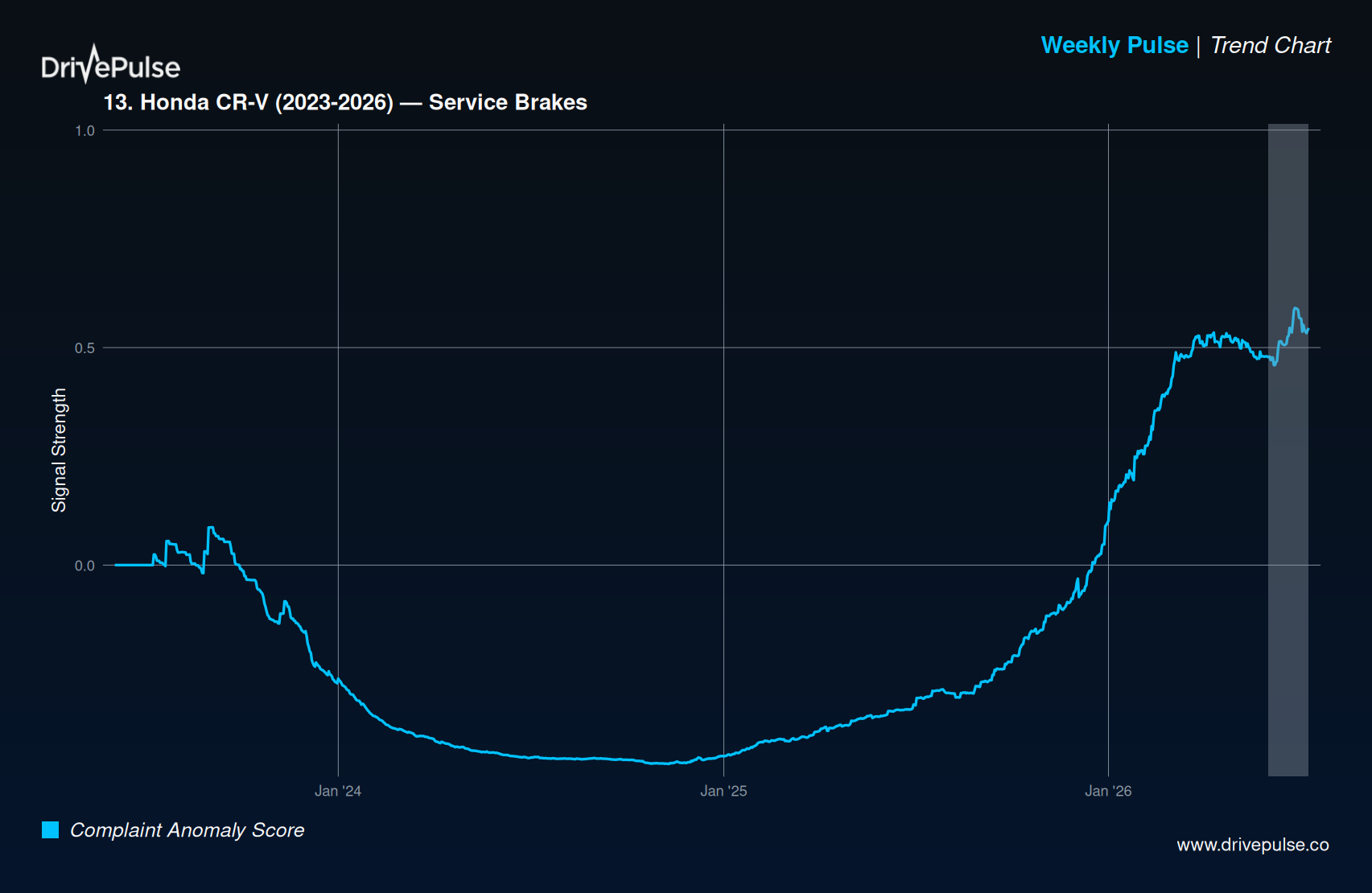
What We're Seeing: Complaints describe uncommanded braking or acceleration events associated with the vehicle's driver-assistance systems, along with reports of the forward-collision and camera-based systems failing to engage, and separate reports of reduced hydraulic braking effectiveness. Based on symptoms, this may be related to last week's Other or Unknown issue with the 2025 CR-V.
In the News: This pattern aligns with NHTSA's open investigation (PE22-003, since escalated) into automatic emergency braking activation across an estimated 1.7–2.9 million Honda CR-V and Accord vehicles, which multiple outlets have covered; that investigation references crashes and injuries at the broader population level, though none confirmed as fatal. No recall has been issued.
Why It Matters: This event and Event 11 above both concern CR-V braking behavior but describe distinct symptom patterns (uncommanded driver-assistance braking here versus loss of braking authority there); tracking them separately may help isolate whether one or multiple root causes are involved, which is relevant to Honda's safety and quality teams and to the existing NHTSA investigation.
────────────────────────────────────────
Our last two issues, for the 2017 Chevy Volt and 2021/2022 Chevy Trailblazer have nearly identical symptoms, indicating one or more shared components failing.
Affected Model Years: 2017
Complaints: 24 over 52 days
First Detected: 2026-05-19 | Status: Updated
Event ID: 16b1b2289bc6bcab
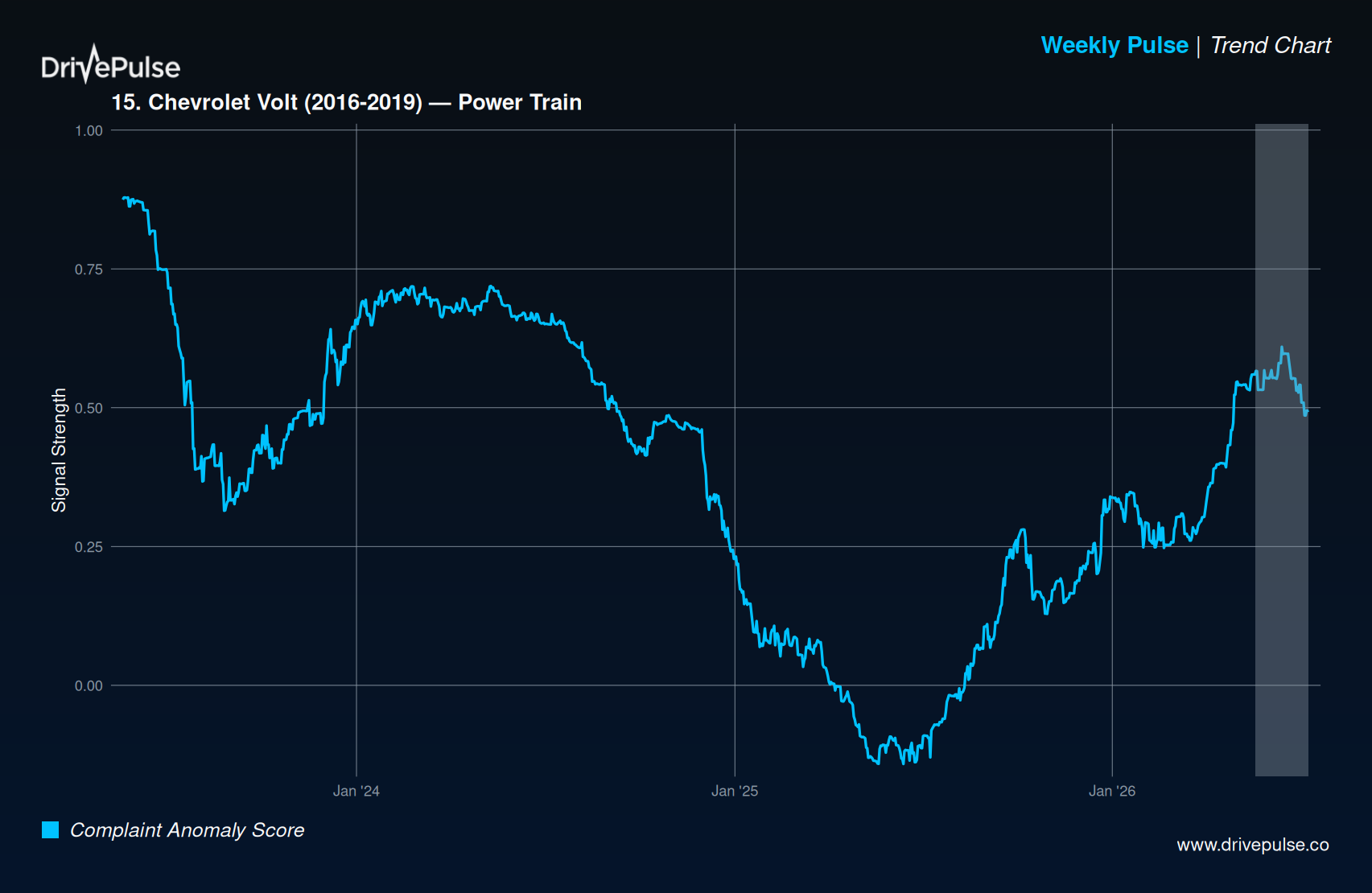
What We're Seeing: Owners describe a "Shift to Park" warning caused by a failed gear- position sensor that prevents the vehicle from powering off, and a separate Battery Energy Control Module fault that triggers reduced-propulsion warnings, loss of power, and high-voltage battery cell failures.
In the News: No mainstream press coverage found; reporting is limited to owner forums and GM's own extended-warranty bulletins, which cover BECM replacement (bulletin N232432680) and a related reduced-propulsion campaign (N202307990) as goodwill coverage rather than a formal safety recall.
Why It Matters: Sudden loss of propulsion at highway speed, addressed through warranty bulletins rather than a recall, is a pattern relevant to teams evaluating whether goodwill-coverage remedies are achieving the same real-world outcome as a formal recall would.
────────────────────────────────────────
Affected Model Years: 2021, 2022
Complaints: 26 over 30 days
First Detected: 2026-06-10 | Status: Updated
Event ID: 8e60cab658742db5
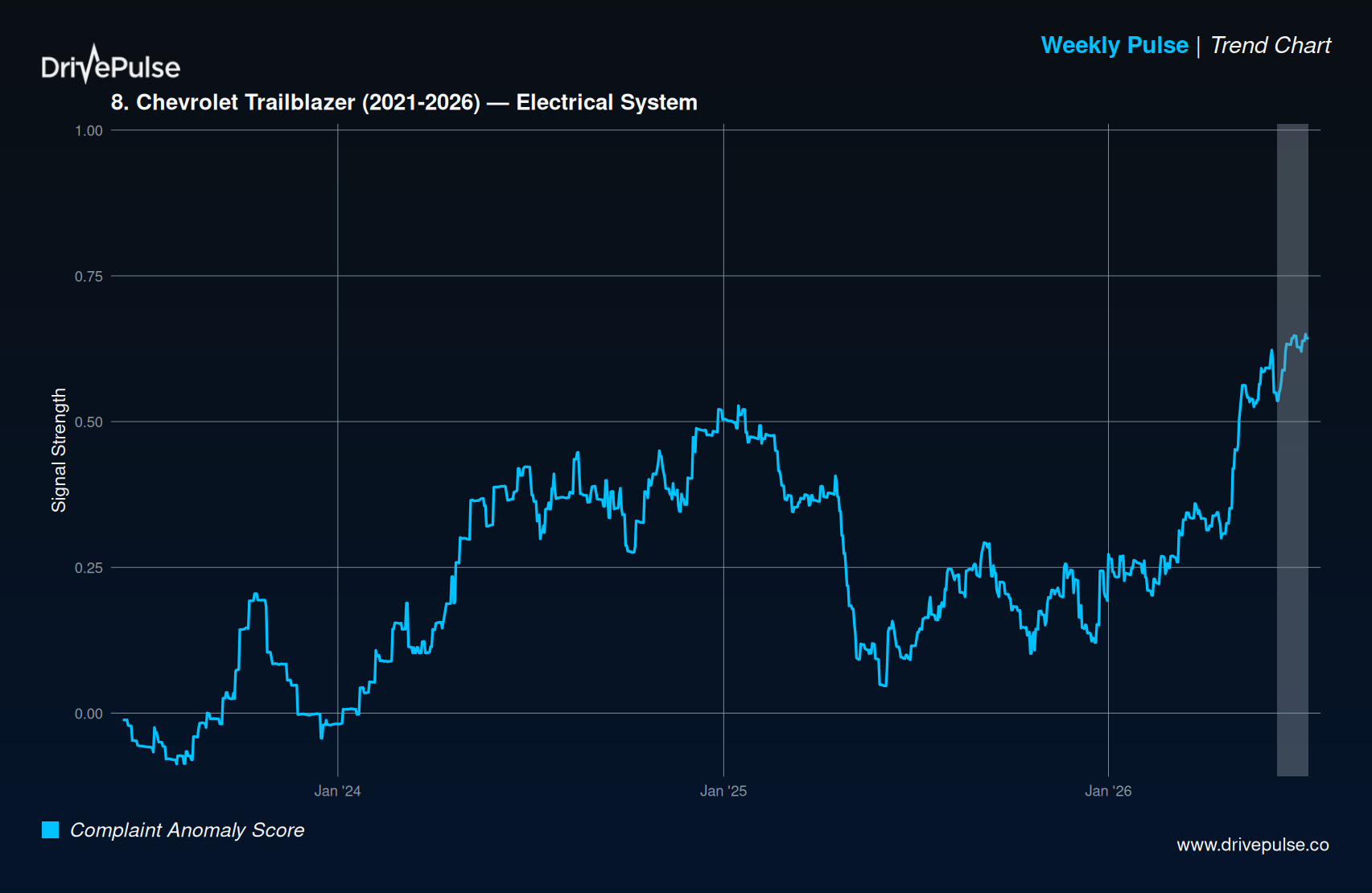
What We're Seeing: Owners describe a persistent "Shift to Park" warning that keeps the vehicle in accessory mode and drains the battery, along with separate low-voltage electrical faults and occasional stalling linked to fuel-system or sensor wiring.
In the News: GM has issued a technical service bulletin (23-NA-119) addressing the shift-to-park condition but has not issued a recall; a 2024 class-action filing in Michigan alleges the defect should be addressed as a safety recall across several GM models sharing the platform. No mainstream press coverage found beyond legal-industry sources.
Why It Matters: A vehicle that cannot fully power down, combined with litigation pressure for recall treatment that has not yet resulted in one, is a pattern relevant to GM's safety and quality teams tracking the gap between TSB-level and recall-level remedies.
────────────────────────────────────────
Data sourced from the NHTSA complaints database, current through July 8, 2026. Statistical detection by DrivePulse.
DrivePulse | drivepulse.co