
This week's signals: a battery-draining "Shift to Park" fault on the Chevrolet Trailblazer, persistent sunroof and mirror issues on the Honda CR-V, piston-ring failures on the Honda Pilot resolved only by warranty extension, electrical faults on the Volvo EX90 distinct from its existing recalls, an EyeSight driver-assist pattern on the Subaru Ascent tied to an active lawsuit, and braking irregularities on the Dodge Charger Daytona EV.
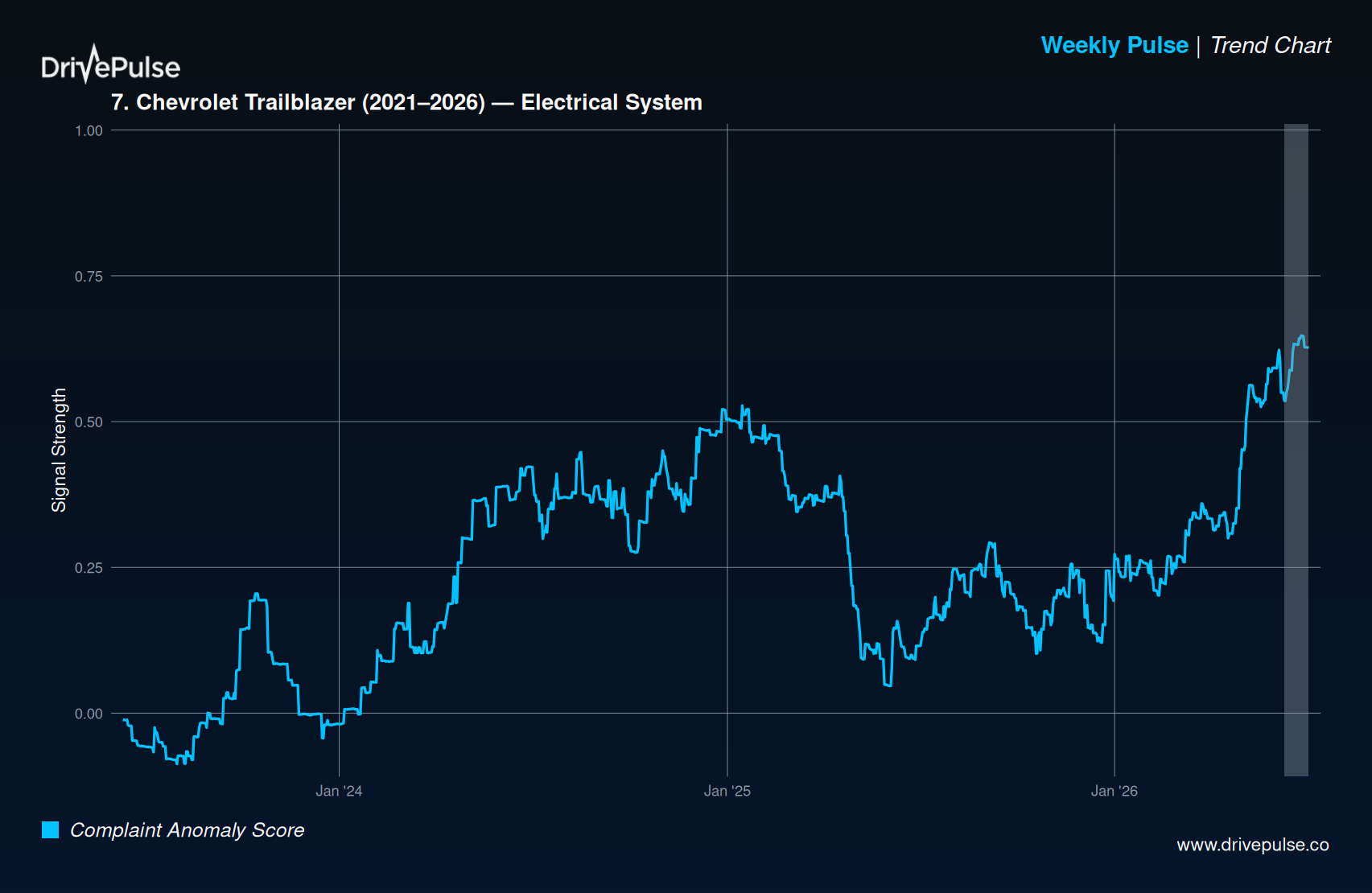
Affected Model Years: 2021, 2022
Complaints: 26 over 23 days
First Detected: 2026-06-10 | Status: Active
Event ID: 9437269a9130ad22
What We're Seeing: Owners describe a recurring "Shift to Park" warning that appears even when the vehicle is already in Park, preventing the engine from shutting down and draining the battery overnight. Some complaints report sudden engine stalls or power loss or loss of power-steering or brake-assist function.
In the News: Owner forums and complaint aggregators document the "Shift to Park" pattern extensively across 2021-2023 Trailblazer and Encore GX models. GM's technical service bulletins attribute the root cause to a park-position switch that fails to correctly signal the body control module; the pattern is addressed via bulletin rather than a safety recall.
Why It Matters: A defect capable of preventing normal vehicle shutdown and draining the battery, addressed only through a service bulletin, is relevant to quality teams assessing whether current owner-notification and repair pathways are reaching the full affected population.
Affected Model Years: 2025
Complaints: 34 over 28 days
First Detected: 2026-06-05 | Status: Active
Event ID: 274ec5d4243e9a33
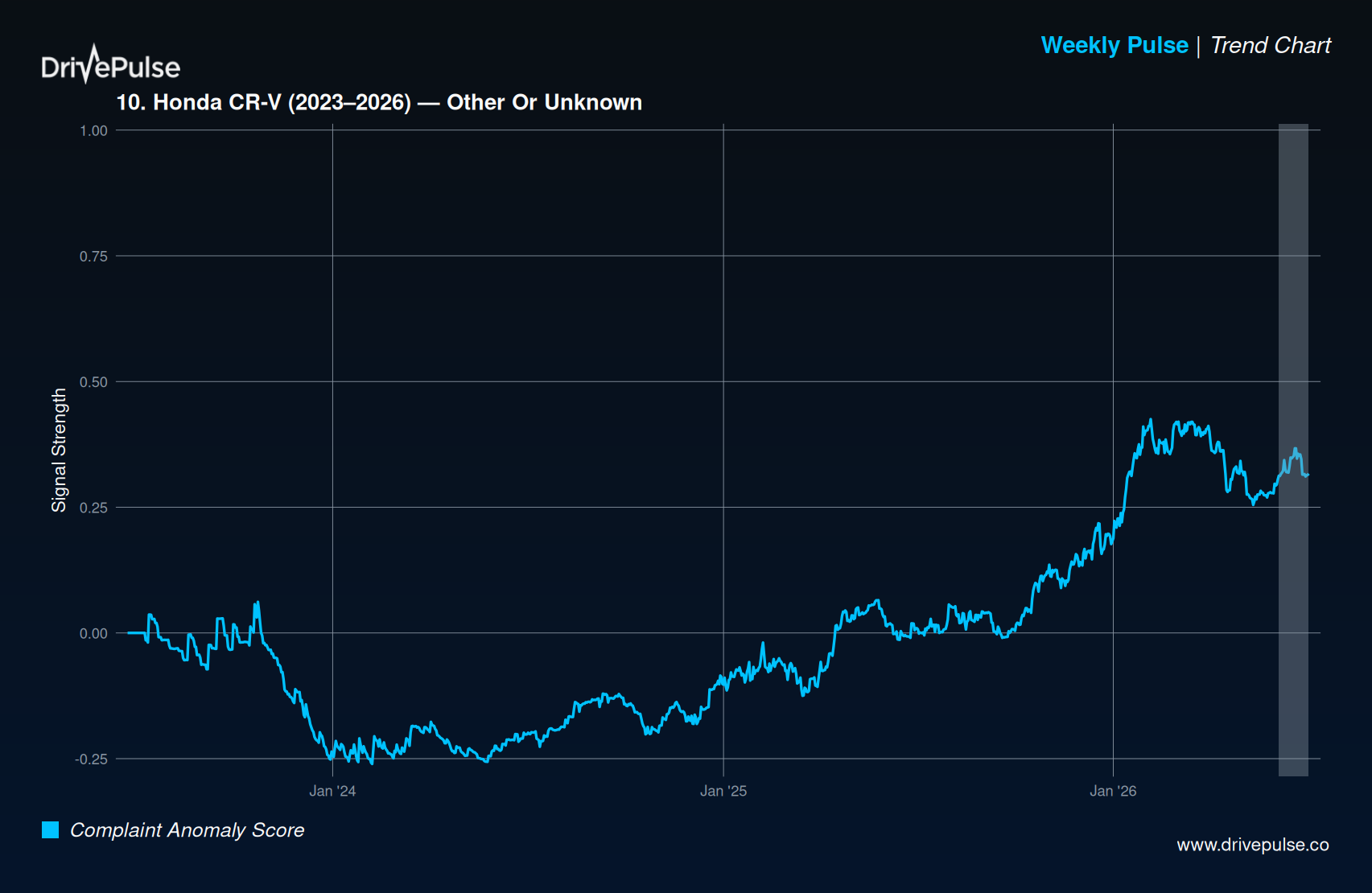
What We're Seeing: Owners report sunroof glass shattering spontaneously with no external impact, a hood that fails to close securely and rattles at highway speed, and side mirrors that develop distortion or cracking that impairs visibility.
In the News: Consumer Reports and multiple class-action trackers cover sunroof "explosion" litigation naming CR-V model years back to 2015 with continuing complaints through current model years; a separate 2024 investigation into mirror distortion has been reported. Some sunroof-glass incidents have caused cuts from flying glass, though no deaths have been reported. No recall currently addresses either issue.
Why It Matters: A sustained, multi-year complaint pattern involving glass integrity that has produced minor injuries in some incidents, without a corresponding recall, is relevant to both quality teams assessing a components supplier issue and safety teams monitoring for injury escalation.
────────────────────────────────────────
Affected Model Years: 2014, 2015
Complaints: 12 over 30 days
First Detected: 2026-06-03 | Status: Active
Event ID: 90d4d882b78c5a88
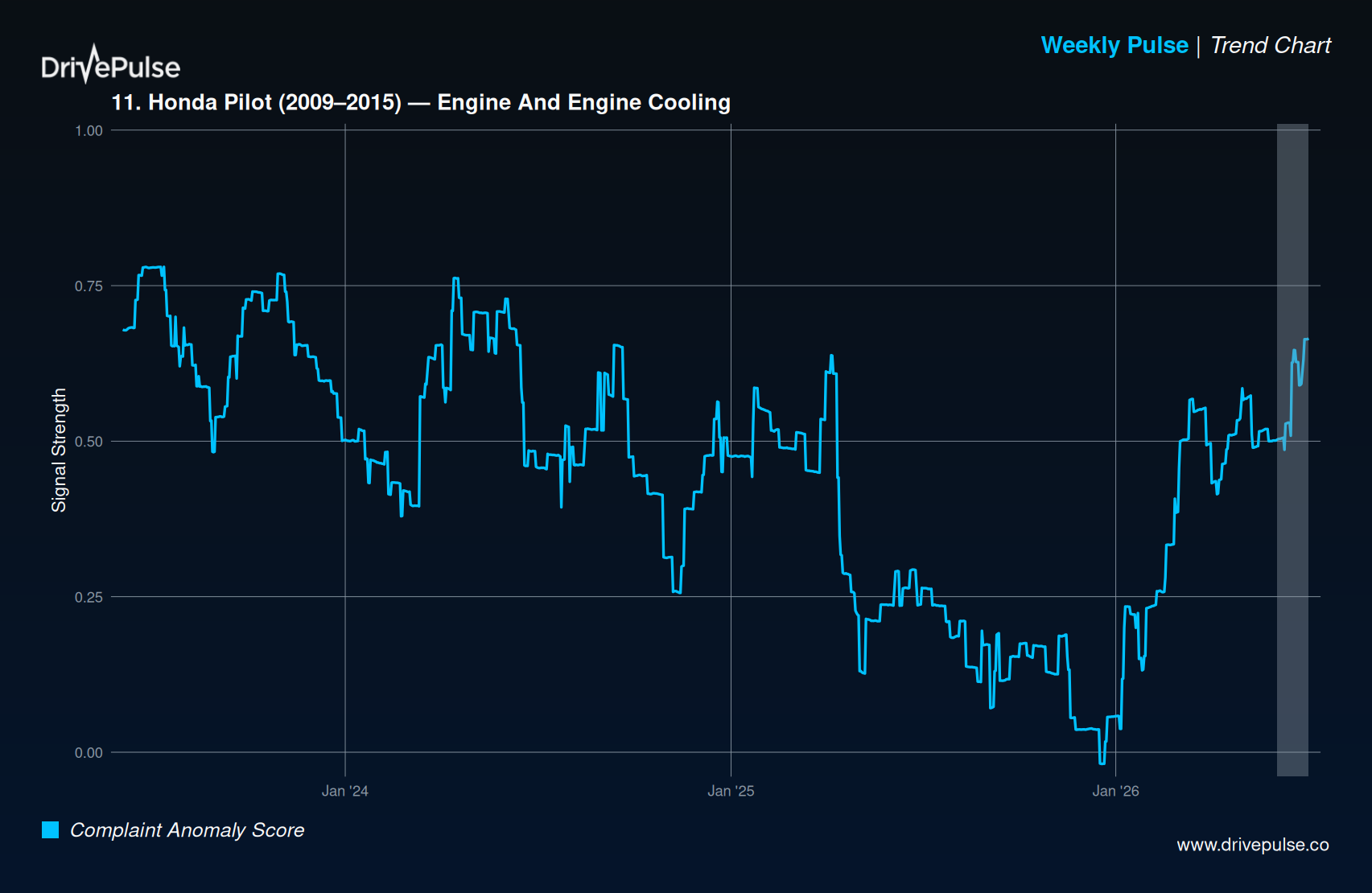
What We're Seeing: Owners report engine misfires linked to piston-ring wear, resulting in oil loss and power loss; secondary complaints describe transmission shift failure and abnormal front-wheel noise.
In the News: Owner forums document extensive piston-ring/oil-consumption failures on 2014-2015 Pilots, with repair costs commonly cited between $3,600 and $7,500. American Honda announced a warranty-coverage extension (to 10 years/150,000 miles) for 2013-2015 Pilot engine-misfire issues in June 2025, addressing the issue outside of a formal safety recall.
Why It Matters: A defect resolved via warranty extension rather than a safety recall, despite a multi-year complaint history and a defined repair cost, is a pattern relevant to quality teams assessing consistency between complaint volume and remedy pathway.
────────────────────────────────────────
Affected Model Years: 2025
Complaints: 10 over 30 days
First Detected: 2026-06-03 | Status: Active
Event ID: 2f8f040c0aa991b8
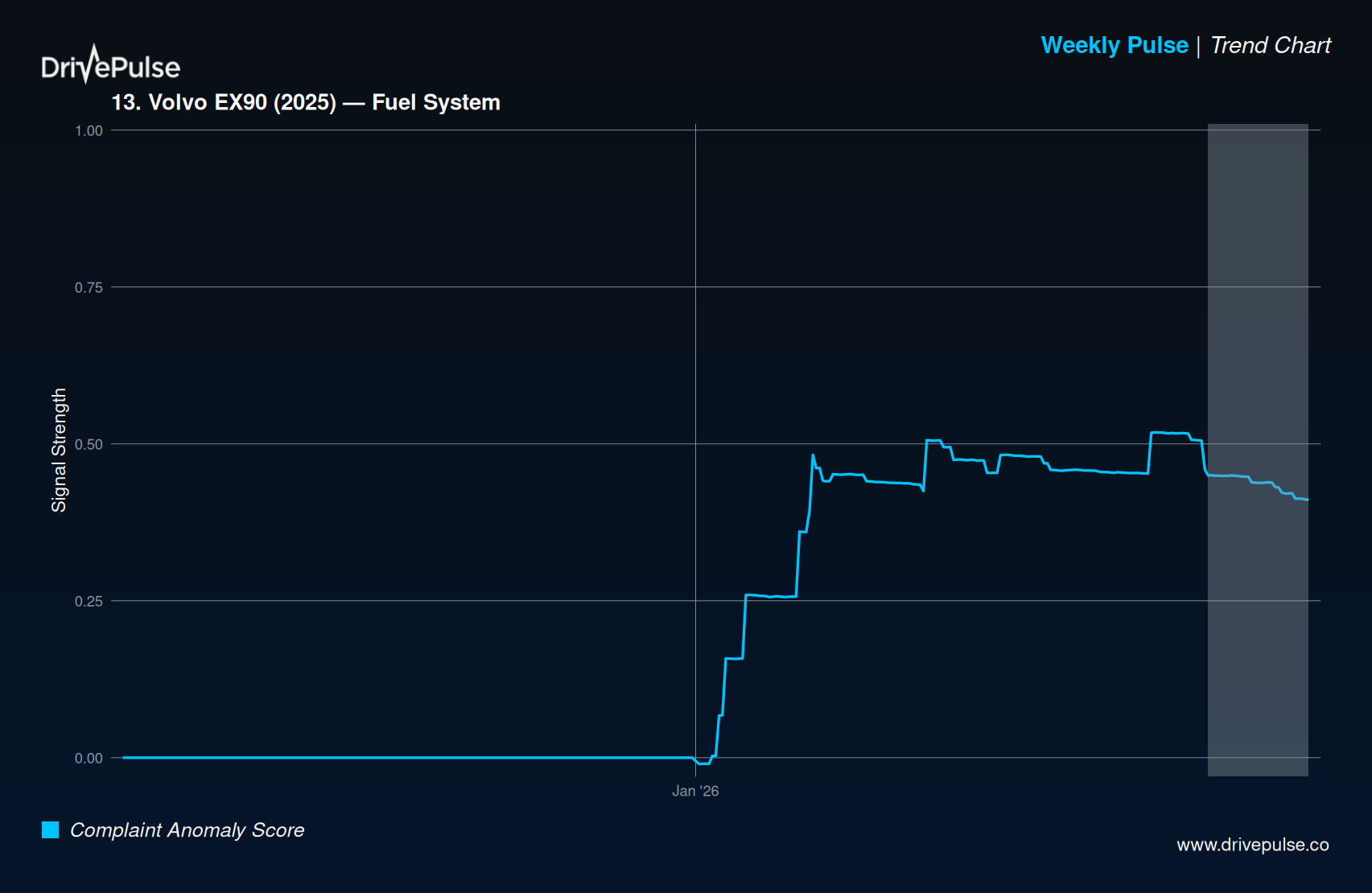
What We're Seeing: Owners report a "Critical Electrical Fault" causing sudden loss of power while driving, an AC charging failure tied to a specific onboard charging component that in some cases prevents home or Level 2 charging, and isolated reports of the vehicle moving forward when reverse is selected while one-pedal drive is engaged.
In the News: Volvo has issued separate 2025 recalls for this model addressing headlight software, a power-tailgate spindle-nut issue, and second-row seat-bolt torque; no recall specific to the AC-charging failure or reverse-gear-override behavior described here was found.
Why It Matters: A pattern of electrical-system faults distinct from the manufacturer's already-issued recalls for the same model is relevant to both the OEM's quality team and regulators tracking whether the current recall population addresses the full range of reported electrical issues.
────────────────────────────────────────
Affected Model Years: 2019, 2020, 2021, 2022, 2023, 2024, 2025
Complaints: 15 over 33 days
First Detected: 2026-05-31 | Status: Active
Event ID: 5efe77537ec61998
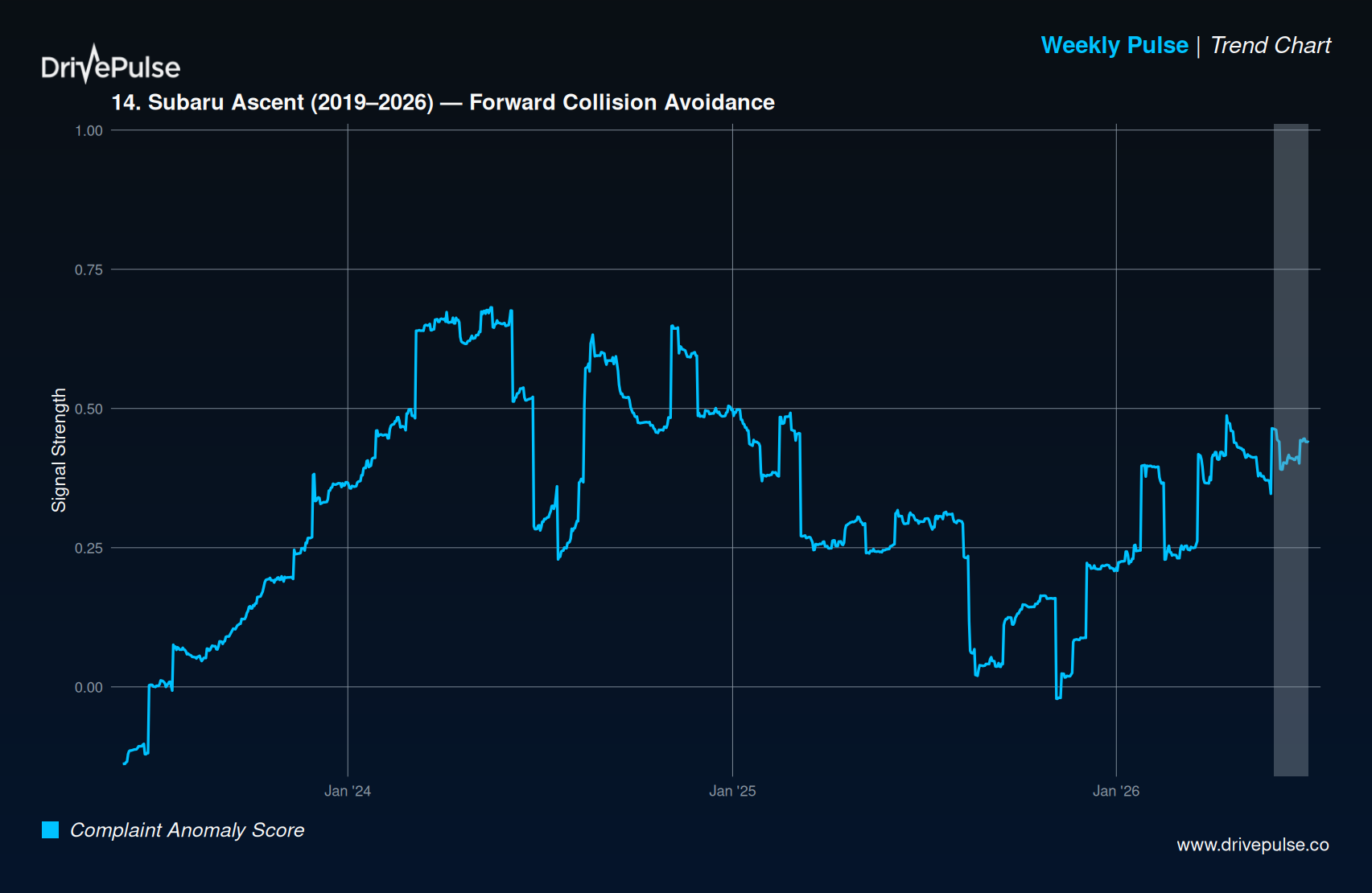
What We're Seeing: Owners report the EyeSight driver-assist system failing to issue pre-collision braking or lane-keep alerts in some conditions, alongside separate complaints of the cruise-control system over-accelerating or the brake pedal not responding as expected, and electrical shutdowns linked to water intrusion.
In the News: A class-action settlement covering Subaru's EyeSight automatic-emergency-braking defect was finalized in July 2025, and a new 2026 lawsuit cites more than 25 NHTSA complaints spanning 2022-2026 model-year vehicles alleging the underlying defect continues. No fatality has been confirmed in this complaint population.
Why It Matters: A driver-assistance defect already the subject of a finalized class-action settlement, with litigation alleging it persists in current model years, is relevant to regulators and safety teams assessing whether existing remedies have resolved the underlying issue.
────────────────────────────────────────
Affected Model Years: 2024, 2025
Complaints: 11 over 33 days
First Detected: 2026-05-31 | Status: Active
Event ID: 8dba7c3abacc8b4d
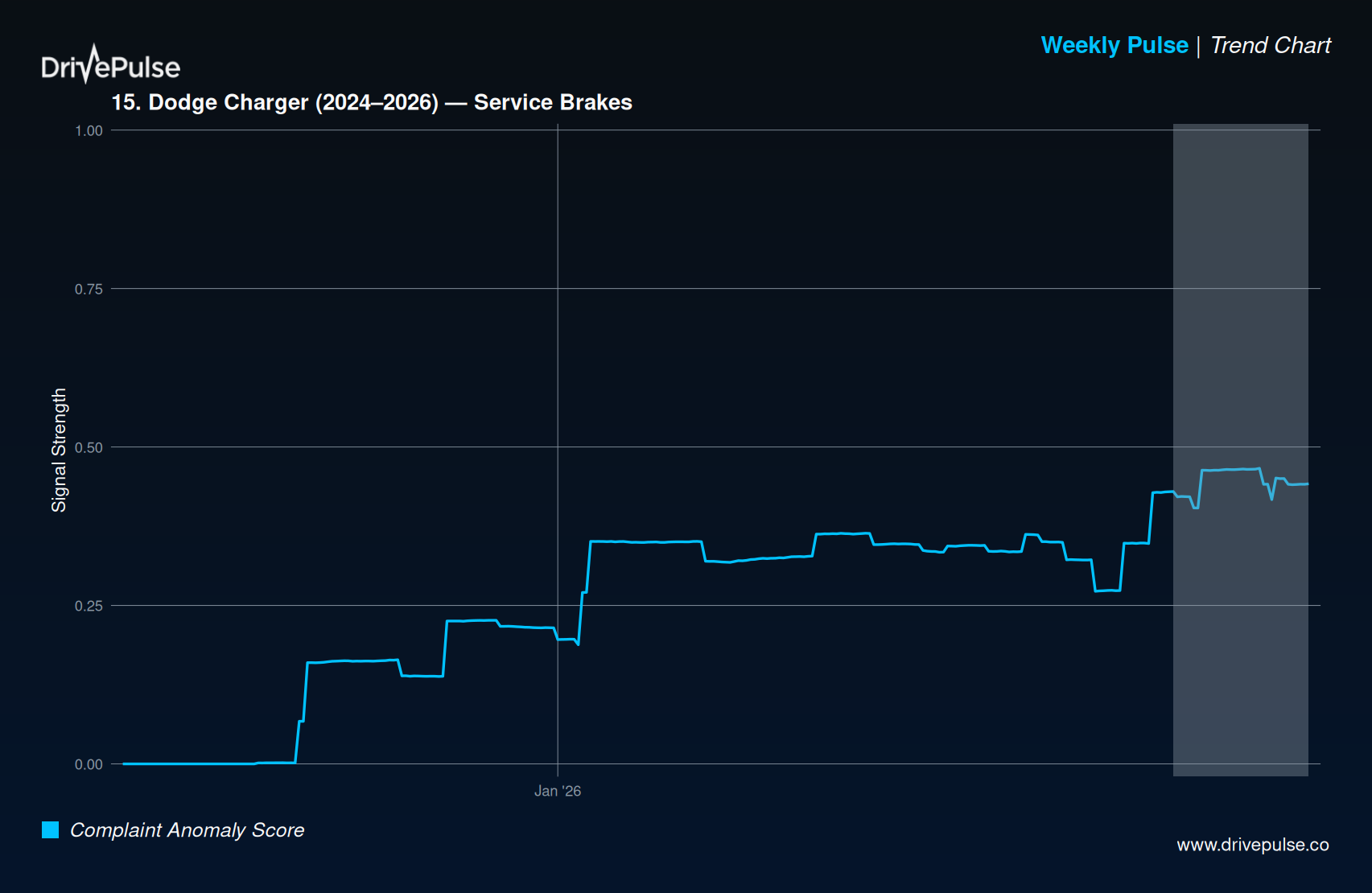
What We're Seeing: Owners of the Charger Daytona EV report ABS, traction-control, and regenerative-braking irregularities that in some cases produce unintended acceleration or rollback and a loss of stopping power; separate complaints describe airbag/collision-sensor faults and charging or electrical instability.
In the News: Edmunds, Motor1, and InsideEVs covered a widely-cited unintended-acceleration incident during long-term testing, with the root cause traced to a drive-torque-calculator fault addressed via technical service bulletin. Dodge has issued separate 2024-2025 recalls for brake-pedal-arm reinforcement, instrument-panel display failures affecting brake telltales, and a park-function spring issue; no recall specific to the regenerative-braking pattern described here was found.
Why It Matters: A braking-system complaint pattern that overlaps with, but is not identical to, several already-issued recalls on the same model is relevant to quality teams evaluating whether current remedies address the full scope of reported braking behavior.
────────────────────────────────────────
DrivePulse | drivepulse.co