
This week's signals: fresh Nu engine complaints on the 2013 Hyundai Elantra, residual battery complaints on the Mercedes-Benz EQB after three recalls, compound EV powertrain failures on the BMW i4, wiring harness fire risk on the 2014–2018 Mercedes-Benz Sprinter, a persistent coolant leak on the Toyota Prius, and phantom braking on the 2025 Mitsubishi Outlander.
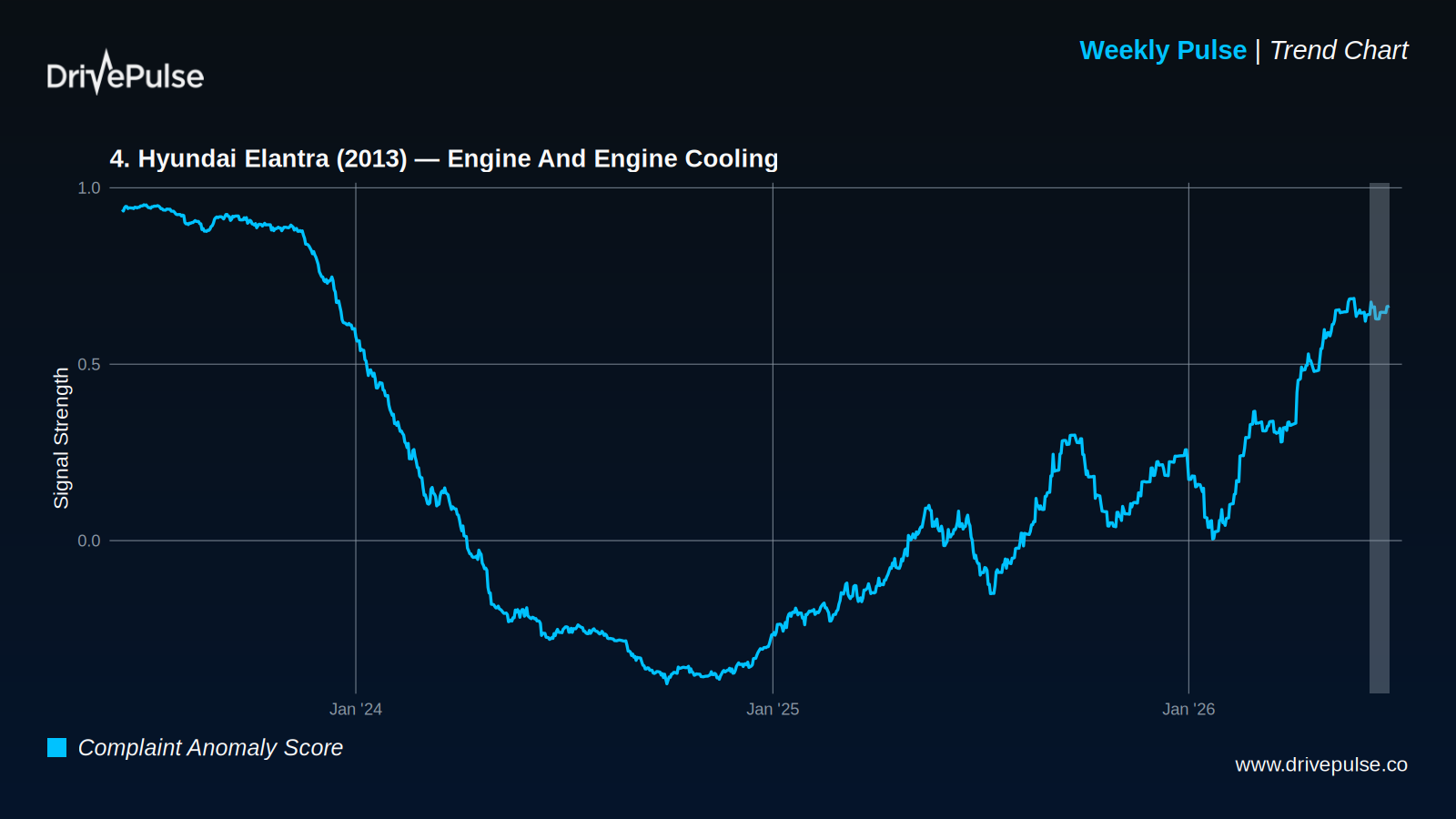
DrivePulse detects defect events across passenger vehicles, commercial platforms, tires, and automated driving systems. The following represent the most notable patterns in recent NHTSA complaint data — early signals that may or may not develop into formal recalls. None of the events below constitute a safety determination; they represent statistical anomalies in consumer complaint patterns that warrant attention from safety and quality teams.
Affected Model Years: 2013
Complaints: 15 over 10 days
First Detected: 2026-06-09 | Status: New Detection
Event ID: 511b4ab0c88fdb7b
What We're Seeing: The 2013 Hyundai Elantra's 1.8L Nu engine is generating fresh complaints in 2026 involving two distinct but related failure modes. The first is crankshaft position sensor failure, which causes sudden engine stalling with no fault codes — the tachometer drops to zero and the vehicle shuts off without warning at any speed. The second is internal bearing failure: complaints describe metallic knocking, piston slap, and in severe cases complete engine seizure, consistent with the machining debris (swarf) retained in oil passages that Hyundai acknowledged through a class action settlement covering 2011–2016 Elantra models.
In the News: A class action settlement reached in 2022 covers 2011–2016 Hyundai Elantra vehicles with the 1.8L Nu engine. The continued arrival of fresh complaints in mid-2026 suggests either that settlement outreach has not reached all affected owners, or that engine degradation in the broader population is continuing to manifest more than a decade into vehicle life.
Why It Matters: Engine stall events caused by crankshaft sensor failure create a secondary traffic hazard on active roadways. The persistence of Nu engine complaints on a vehicle that has largely exhausted standard warranty coverage suggests quality teams should examine in-service failure rates in the 10-to-15-year vehicle age cohort.
Affected Model Years: 2023
Complaints: 13 over 26 days
First Detected: 2026-05-25 | Status: Updated
Event ID: 5e0d458e8ce121d8
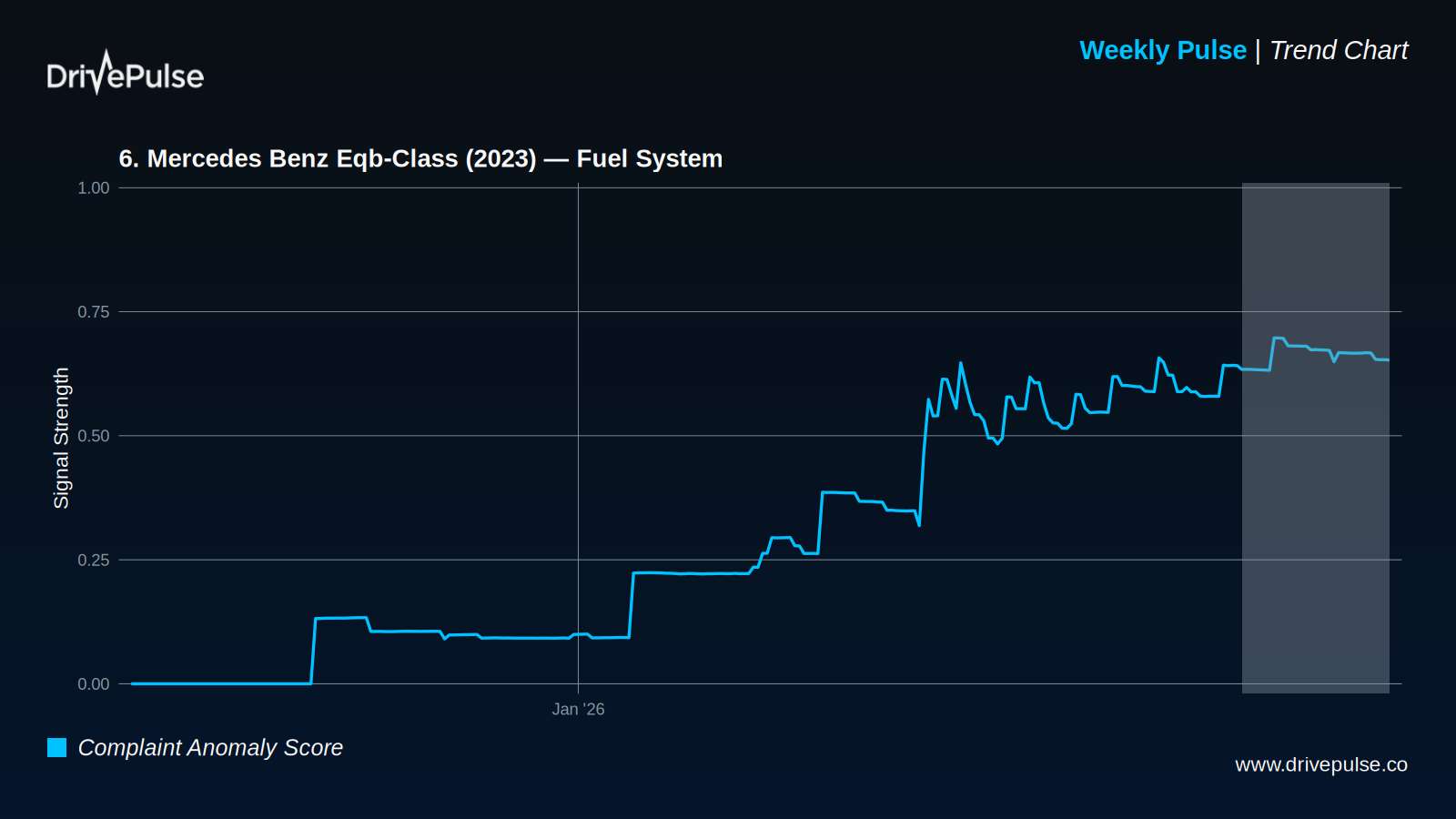
What We're Seeing: Our system is detecting continued complaint activity in the Mercedes-Benz EQB fleet involving high-voltage battery performance — notable because the EQB has been subject to three separate NHTSA recall campaigns for battery fire risk. The complaint pattern reflects owners still experiencing reduced range (capped to 80% state of charge), extended DC fast-charge times, and in some cases sudden loss of drive power at speed, even after receiving the BMS software update intended to address earlier recalls. This detection likely reflects complaints from vehicles that have received only the interim software remedy, not the full battery pack replacement now required under the February 2026 recall.
In the News: Mercedes-Benz issued its third EQB battery fire recall (NHTSA 26V073) in February 2026, requiring full high-voltage battery pack replacement on approximately 11,895 U.S. vehicles after post-repair fires were reported in Europe. InsideEVs and The EV Report covered the third recall. The NHTSA classification of this event as "Fuel System" is a legacy taxonomy artifact — the underlying issue is a high-voltage battery cell defect.
Why It Matters: Continued complaint activity after multiple recall remedies is itself a signal. It indicates either that the battery replacement campaign has not yet reached all affected vehicles, or that quality teams should monitor warranty return rates on replaced packs. DrivePulse is detecting the residual complaint tail of an unresolved high-voltage battery quality issue.
Affected Model Years: 2023, 2024, 2025
Complaints: 11 over 16 days
First Detected: 2026-06-03 | Status: Updated
Event ID: 48b0263758933017
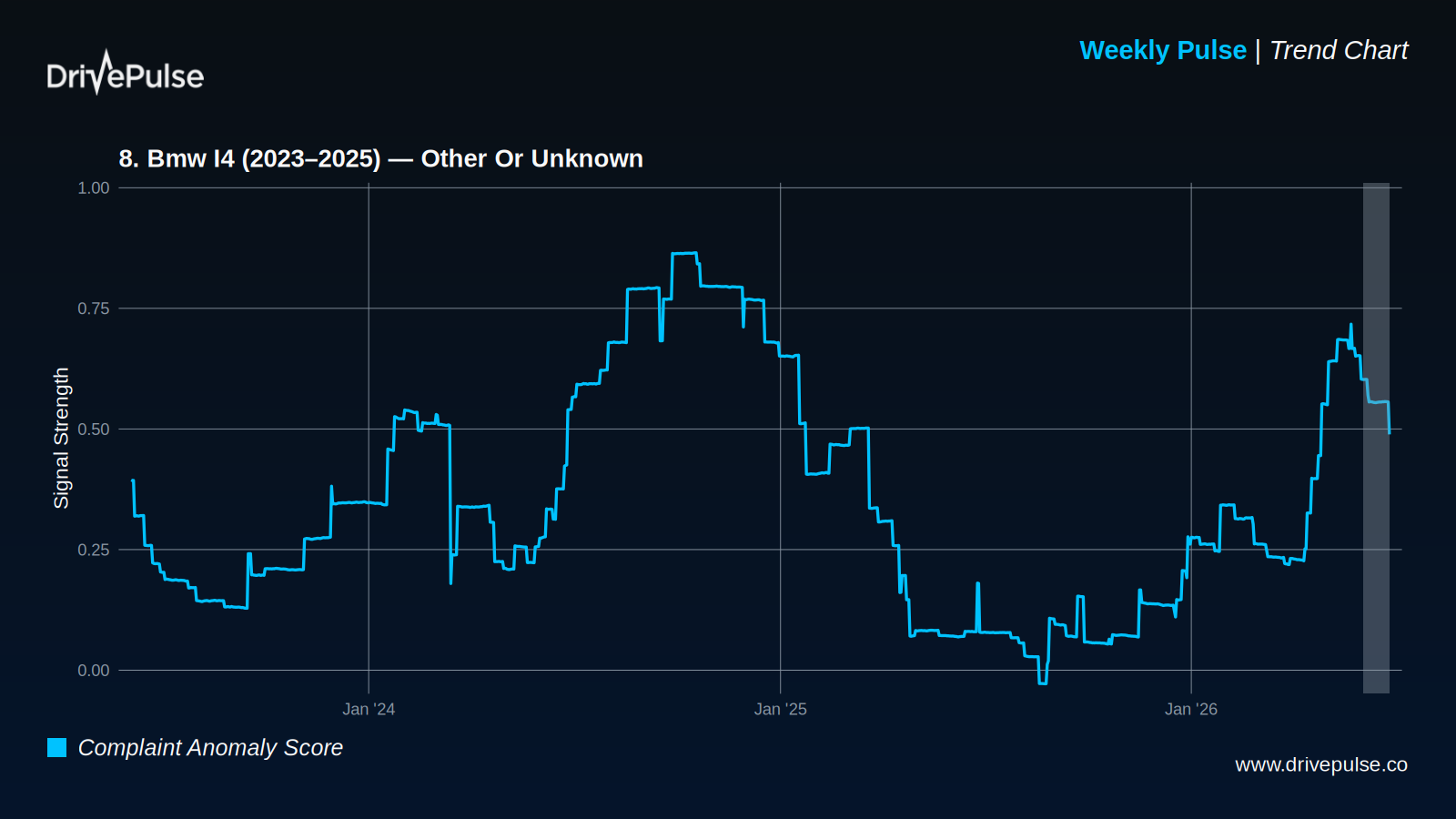
What We're Seeing: The BMW i4 is generating complaints across three distinct failure domains. The first involves episodes of unexpected acceleration — the vehicle surging without driver input and failing to decelerate normally under brake application. The second involves sudden lateral instability during highway driving: the vehicle pulling or jerking sharply to one side without warning, not corrected by wheel alignment or tire replacement. The third involves high-voltage system events: sudden thermal events in the engine compartment described in some complaints, main display blackouts, and loss of drive power. BMW's 2025 electric drive unit recall (NHTSA 25V857) addresses some loss-of-drive scenarios but does not appear to cover the acceleration or steering instability patterns now visible in NHTSA data.
In the News: Lemberg Law and similar consumer advocacy sites have documented the 2023 BMW i4 complaint pattern. A high-voltage battery module recall was issued in 2023; a separate electric drive unit software recall was issued in June 2025. Neither addresses the unintended acceleration complaints currently active in the NHTSA database.
Why It Matters: Unintended acceleration combined with high-voltage thermal events on a premium battery-electric vehicle represents compound risk. Safety engineers tracking EV powertrain complaint patterns should prioritize this cluster given the range of distinct failure modes accumulating on the same platform.
Affected Model Years: 2014, 2015, 2016, 2017, 2018
Complaints: 7 over 14 days
First Detected: 2026-06-05 | Status: New Detection
Event ID: 0ca9860a88f3d1cf
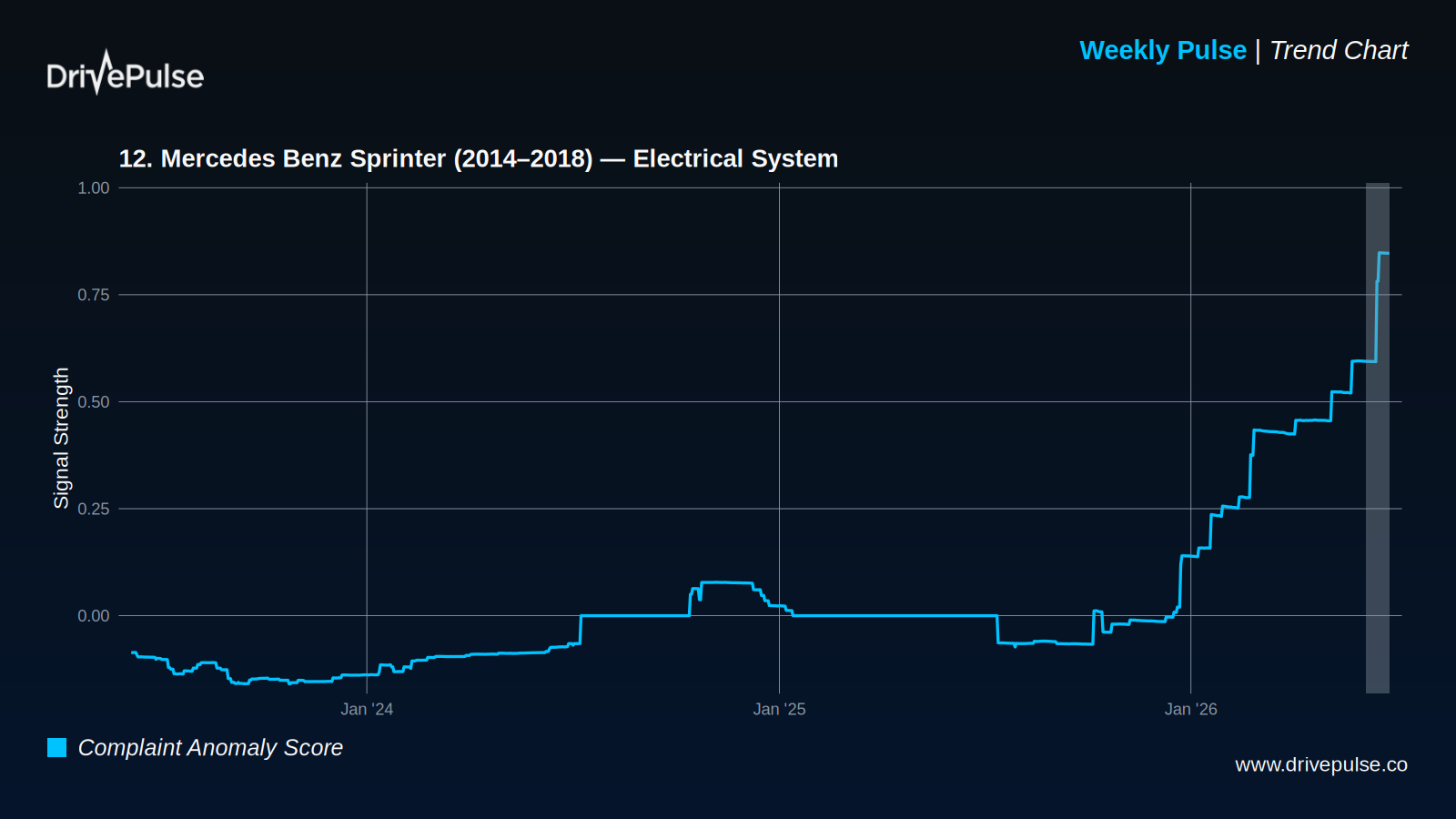
What We're Seeing: The 2014–2018 Mercedes-Benz Sprinter is generating fresh electrical system complaints spanning several subsystems. The most prevalent pattern involves rear wheel speed sensors failing electrically, which disables the ESP electronic stability program — a significant concern on a commercial van platform that often operates at elevated cargo weights. A second and more acute pattern involves wiring harness routing: complaints describe the main harness contacting the driveshaft over time, causing chafing and eventual short circuit that can result in fire risk, sudden loss of motive power, or failure of power steering and brake control. A third pattern involves unexplained electrical events including spontaneous awakening and deployment of the powered awning and steering wheel overheating with a burning odor.
In the News: NHTSA has issued prior recall campaigns for the Sprinter addressing ESP sensor failures and wiring harness routing defects. No press coverage found for this June 2026 complaint cluster — this appears to be an early signal in the NHTSA complaint stream.
Why It Matters: The Sprinter is widely deployed in commercial fleet, last-mile delivery, medical transport, and ambulance configurations. Electrical failures that disable stability control or braking assistance on a heavily-loaded commercial vehicle carry outsized risk relative to passenger car equivalents. Fleet safety managers should confirm that their Sprinter inventory is current on all relevant recall remedies.
Affected Model Years: 2016, 2017, 2021
Complaints: 5 over 8 days
First Detected: 2026-06-11 | Status: New Detection
Event ID: 9a767a4d89ef887c
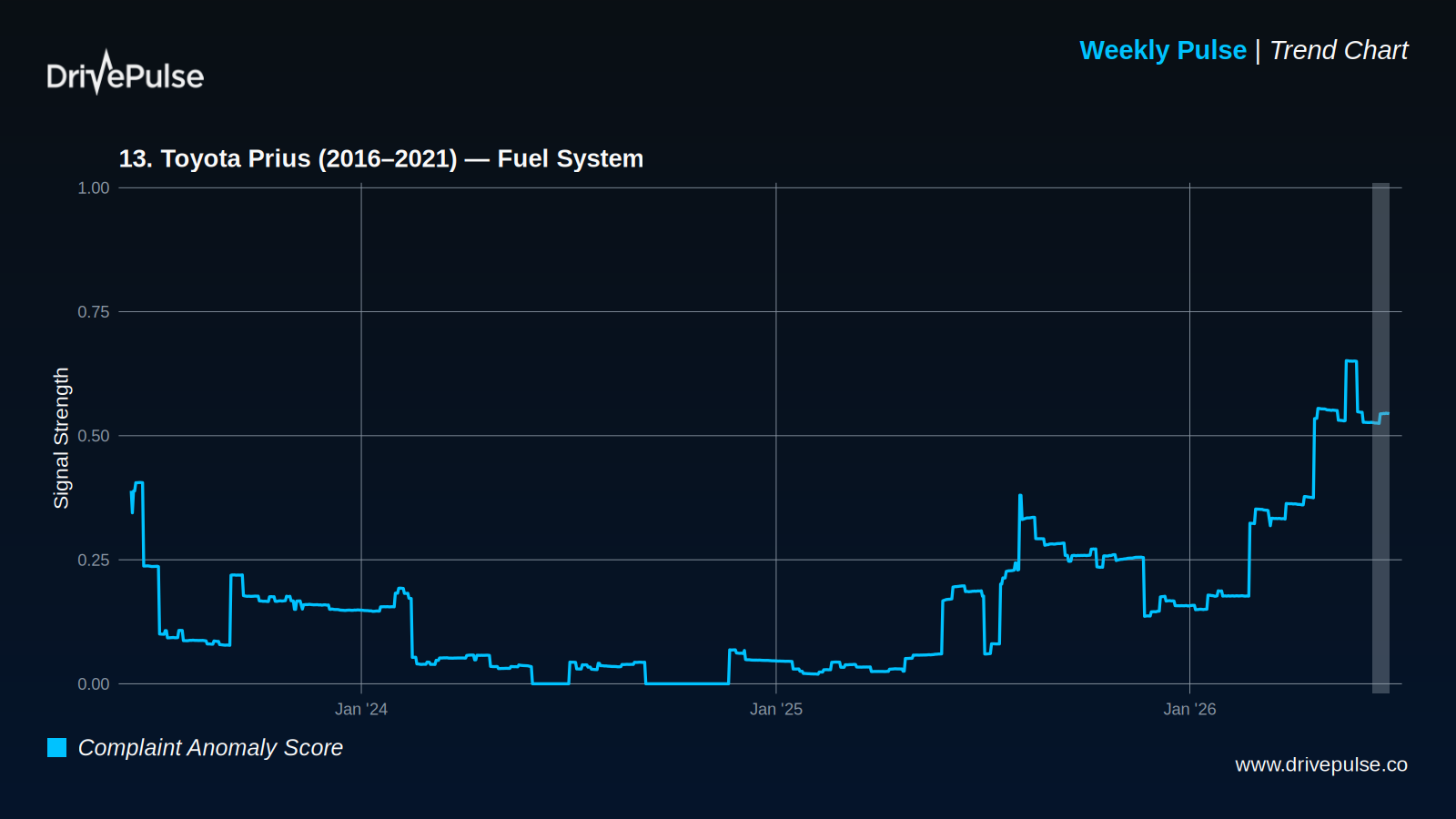
What We're Seeing: The 2016–2022 Toyota Prius continues to generate complaints around an internal coolant leak in the front exhaust pipe heat exchanger assembly — a condition addressed in Toyota Technical Service Bulletin T-SB-0135-19, issued in 2019. Affected vehicles exhibit gradual coolant loss with no visible external leak, triggering Check Engine illumination (DTC P148F00) and, in some cases, white exhaust smoke. A subset of complaints describes intermittent engine stalling at operating temperature, consistent with coolant vapor effects on the combustion system. A smaller number of complaints also reflects a hybrid battery management anomaly where the electric drive disengages prematurely, forcing the engine to run alone.
In the News: Toyota's TSB T-SB-0135-19 covers the front exhaust heat exchanger coolant leak for 2016–2019 Prius under the Federal Emission Warranty (8 years/80,000 miles). Complaints on CarComplaints.com and PriusChat forums reflect owners whose vehicles are outside warranty coverage for this repair. No new NHTSA recall or press coverage found for this 2026 complaint cluster.
Why It Matters: The coolant leak represents a potential thermal hazard — hot coolant contacting exhaust components — and the warranty coverage boundary means that older vehicles in the affected population may not receive the repair without out-of-pocket cost. Quality teams should monitor in-service failure rates in the post-warranty 2016–2017 Prius cohort.
Affected Model Years: 2025
Complaints: 5 over 7 days
First Detected: 2026-06-11 | Status: New Detection
Event ID: 0588877200dceb10
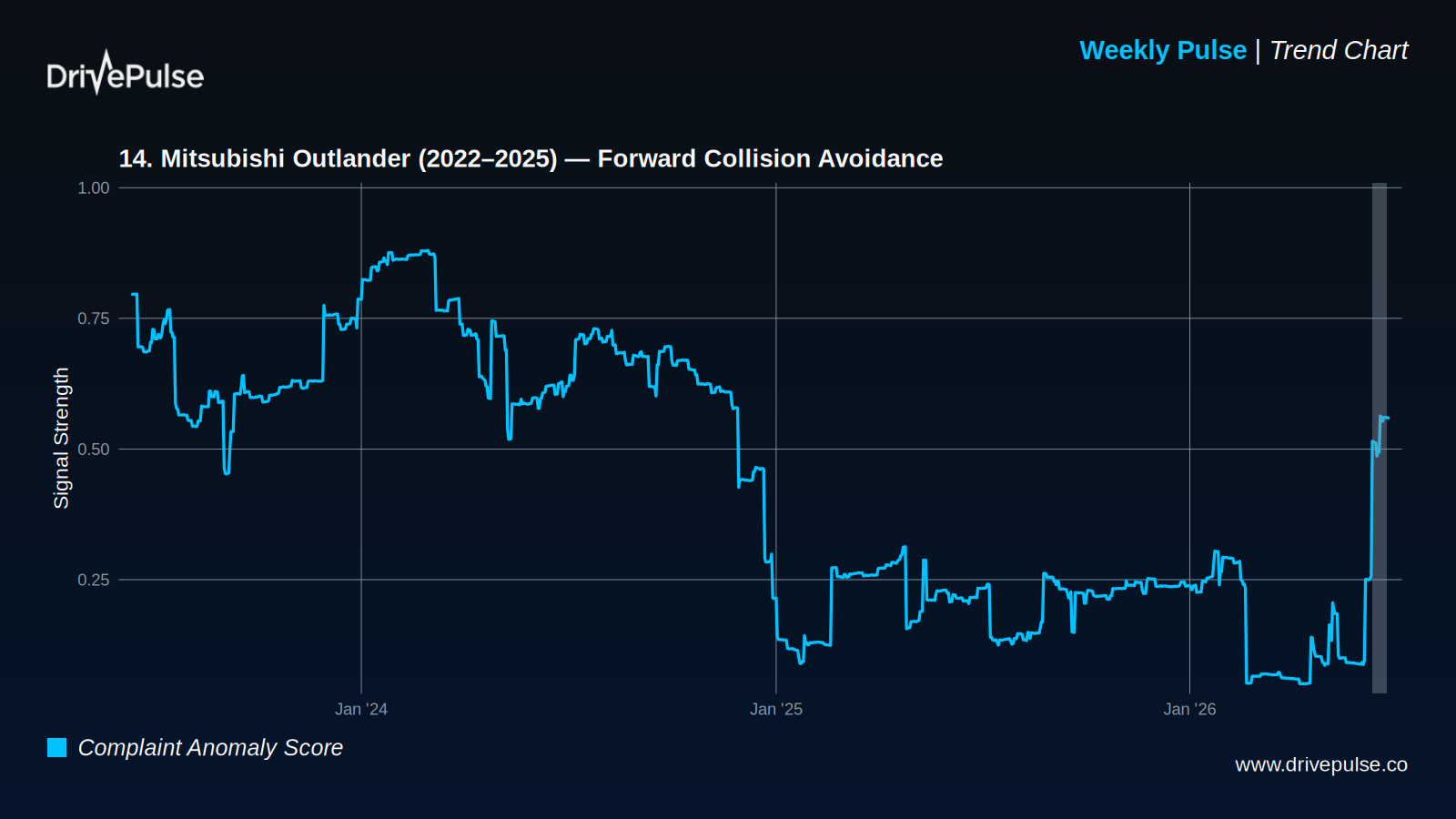
What We're Seeing: The 2025 Mitsubishi Outlander is generating complaints in which the Forward Collision Mitigation (FCM) system and Adaptive Cruise Control are behaving inconsistently. The most common pattern is ACC disengaging without driver input while the FCW indicator cycles on and off. A smaller subset of complaints describes the system applying full braking force at intersections or during lane changes in the absence of any obstacle — phantom braking consistent with radar misinterpretation or sensor miscalibration. A separate cluster involves unexpected low-speed throttle-unresponsive acceleration, suggesting a possible brake/throttle actuation fault distinct from the FCM software pattern.
In the News: Mitsubishi previously recalled certain 2017–2018 Outlander and Eclipse Cross vehicles for an FCM software defect involving prolonged braking after a pedestrian was no longer detected. No press coverage has been found for this 2025 model year complaint cluster — this appears to be an early signal.
Why It Matters: Forward collision avoidance system failures resulting in phantom braking represent an emerging complaint category that NHTSA is tracking across multiple OEMs. Safety teams should assess whether the current complaint pattern in the 2025 Outlander aligns with the prior FCM recall and whether an applicable software remedy exists for current production vehicles.