
A GMC Acadia steering-warning/coolant cluster that's grown 58% since July. A Tesla Model X pattern, power loss coinciding with doors that won't open, that echoes two prior fatal/near-fatal egress incidents and an active lawsuit. A first-year Hyundai Ioniq 9 ICCU failure mode matching an issue already under NHTSA review on the Ioniq 5. And a Ford Mustang EcoBoost cluster where a recalled fuel-pump fault and an unrelated purge-valve fault are showing up in the same complaints, muddying diagnosis. None are confirmed recalls. These are early statistical signals in complaint data.
DrivePulse detected 25 new defect signals this week. Here are some of the most interesting events DrivePulse detected recently. The following represent notable patterns in recent NHTSA complaint data and owner forum data— early signals that may or may not develop into formal recalls. None of the events below constitute a safety determination; they represent statistical anomalies in consumer complaint patterns that warrant attention from safety and quality teams.
────────────────────────────────────────
Affected Model Years: 2019, 2020, 2021
Complaints: 41 over 134 days
First Detected: 2026-05-05 | Status: Active
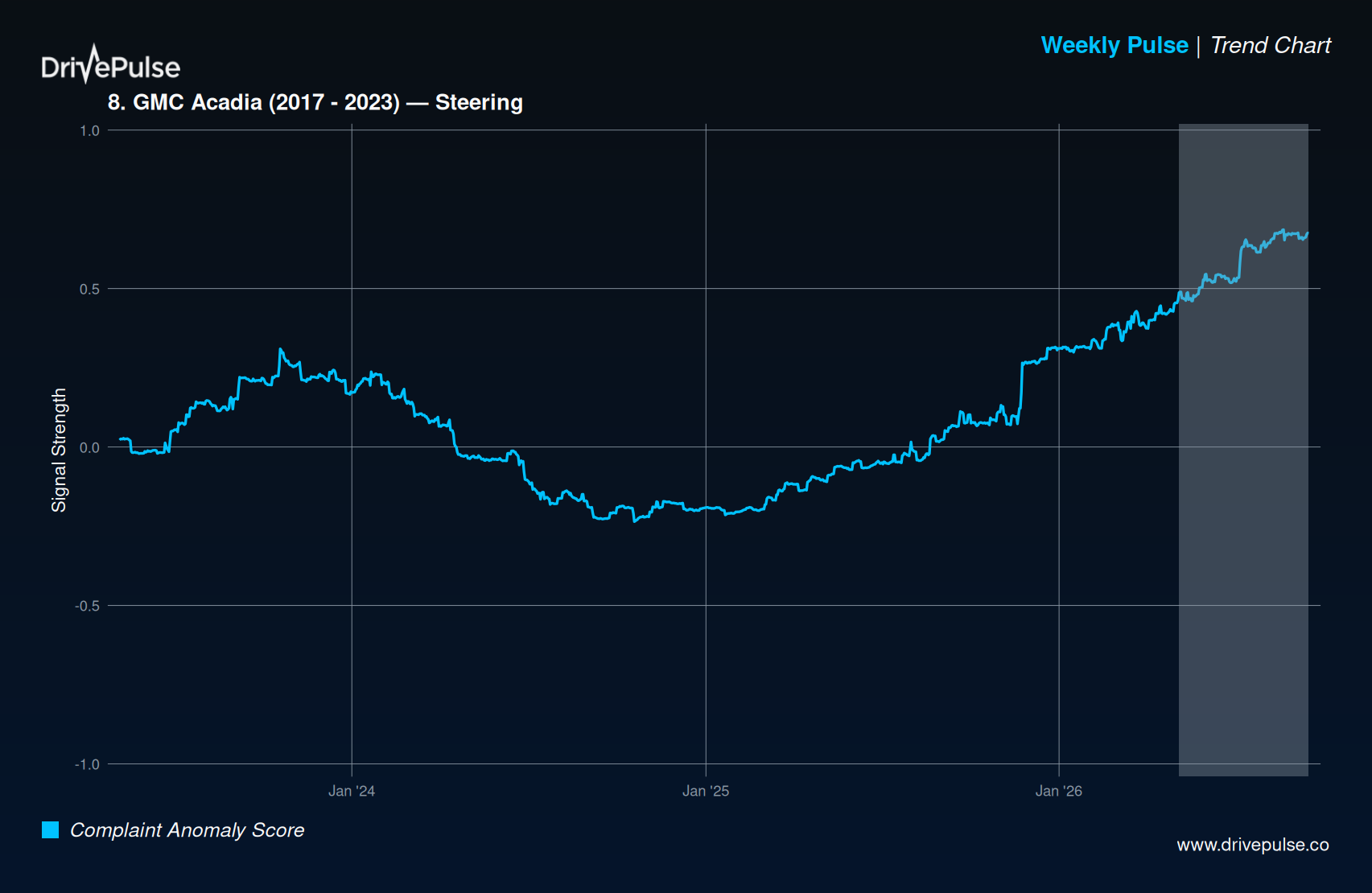
What We're Seeing: Owners report a "Steering Assist Reduced — Drive with Care" dashboard message that coincides with a stuck or invalid coolant-temperature reading, loss of AC output, and a cooling fan that continues running for 10-20 minutes after the engine is shut off. Owners and GM technical bulletins (PIT5967, N252508350) point to a failed or stuck-open thermostat and an associated ECM-to-steering-module communication fault (DTC U0401) as the likely shared root cause.
In the News: Coverage is limited to owner-forum discussion (acadiaforum.net) rather than press or a formal recall; several forum threads describe the issue as widespread and suggest it warrants a recall, but no NHTSA action was found. This appears to be an early signal ahead of broader attention.
Why It Matters: This event was previously featured with 26 complaints on 2026-07-20; complaint volume has since grown to 41 — roughly a 58% increase — and combined with a warning message that explicitly references reduced steering assist, that continued growth is worth tracking even though the underlying fault (per owner reports) appears to be a thermostat/coolant-sensor issue rather than the steering system itself.
────────────────────────────────────────
Affected Model Years: 2022, 2023
Complaints: 10 over 139 days
First Detected: 2026-04-30 | Status: Active
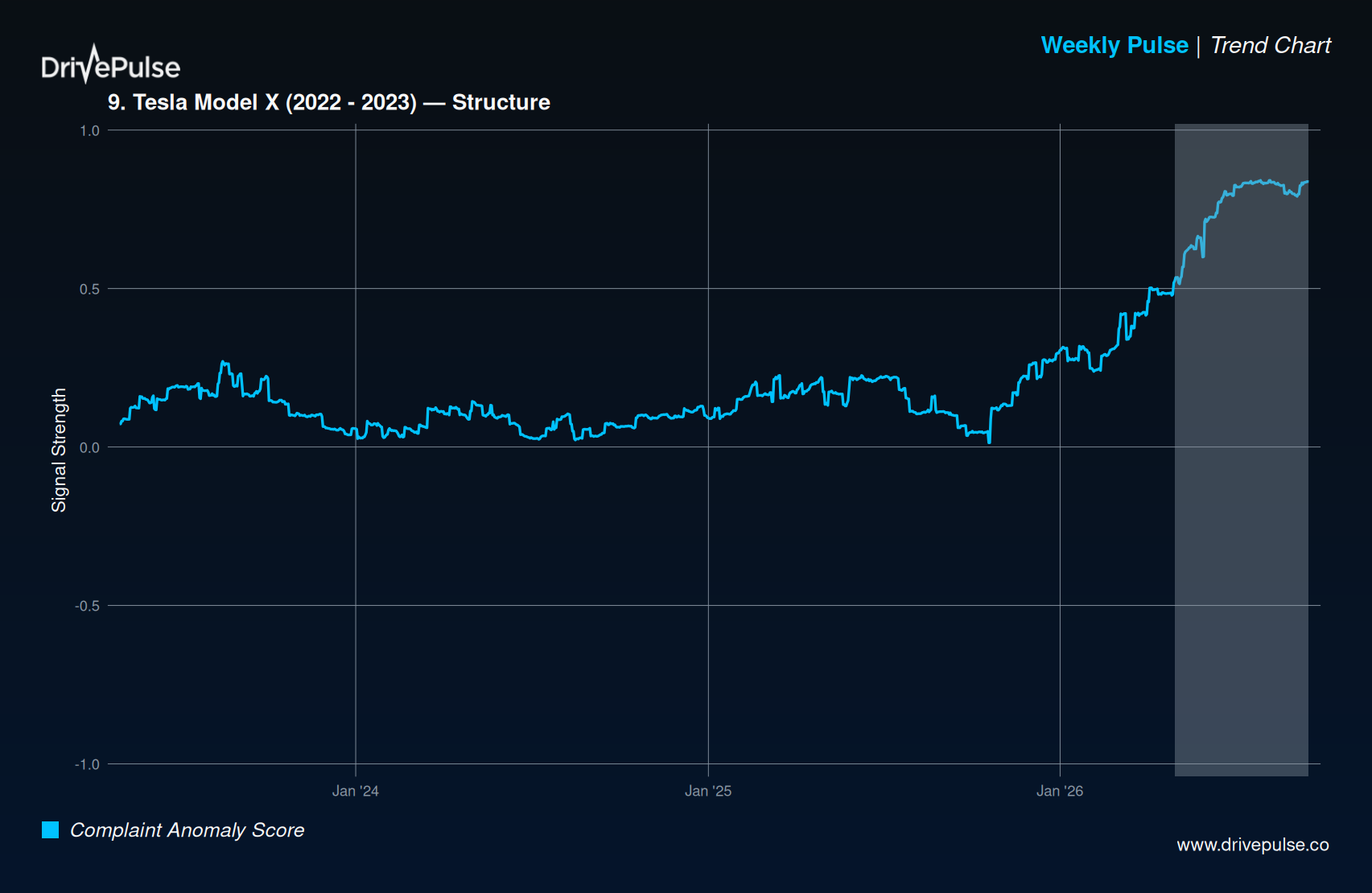
What We're Seeing: Complaints describe several distinct concerns: a high-voltage harness routed near the steering column that owners associate with sudden power loss and doors that will not open, falcon-wing door sensors that owners say fail to detect obstructions (and in some cases pinch or strike objects), fender flares and underbody guards detaching in standing water, and a front-trunk latch that frequently requires multiple attempts to open.
In the News: Falcon-wing door and power-loss concerns on the Model X have drawn sustained press and legal attention. A Model X owner is currently suing Tesla after the falcon-wing doors reportedly failed to open following a fiery crash; two earlier, separate incidents involving occupants unable to exit a Model X after a crash — one in China (2017, serious injury, no fatality) and one in South Korea — have also been reported, the latter involving a fatality when the vehicle caught fire and first responders could not open the doors from outside.
Why It Matters: The specific failure mode described in current complaints — doors that do not reliably open after a loss of power — is the same category of concern as in the previously reported incidents, which makes it directly relevant to Tesla's door-system engineering team and to NHTSA's ongoing monitoring of Model X emergency egress.
────────────────────────────────────────
Affected Model Years: 2026
Complaints: 20 over 147 days
First Detected: 2026-04-22 | Status: Active
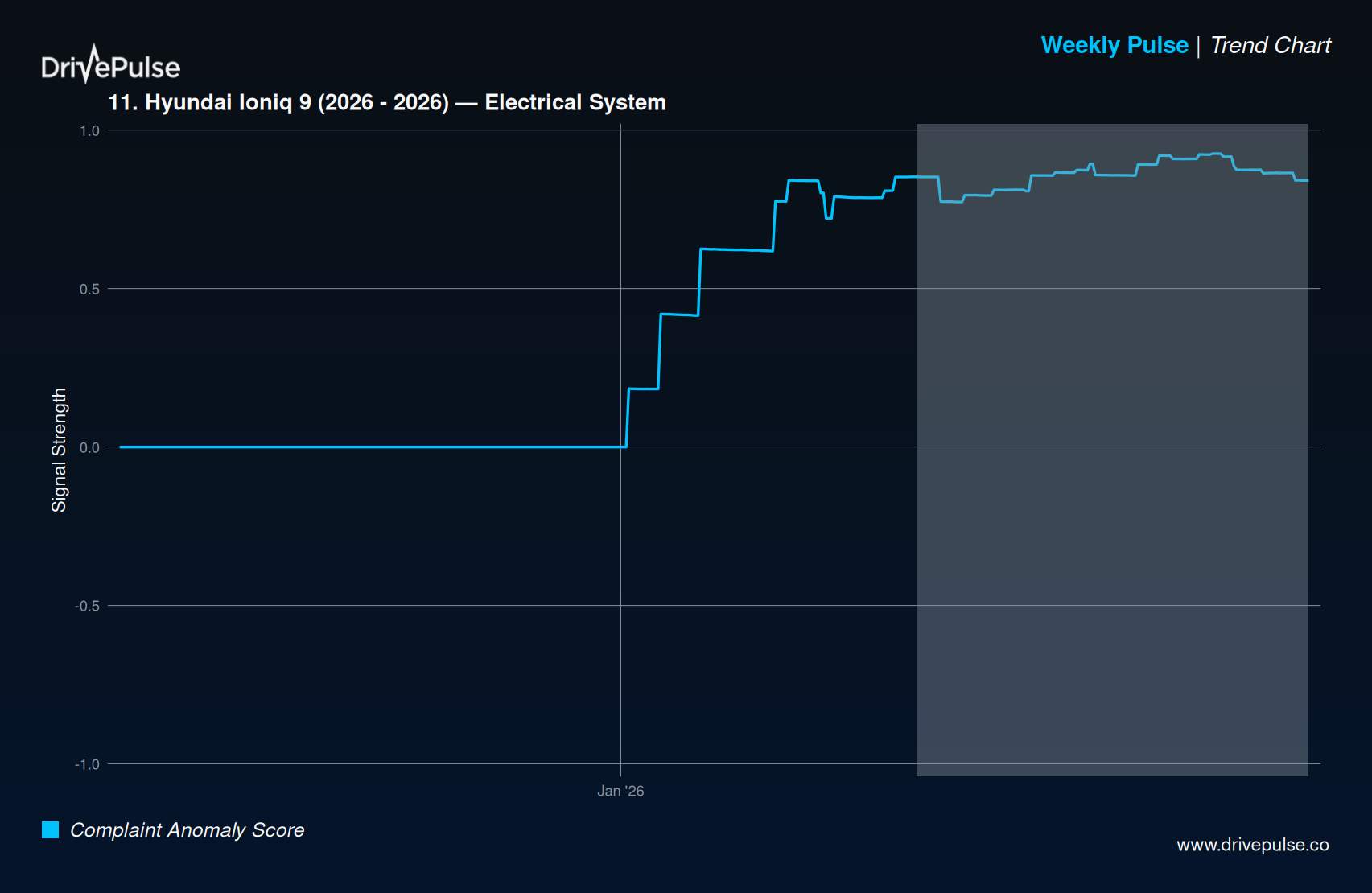
What We're Seeing: The dominant pattern is Integrated Charging Control Unit (ICCU) failure, which owners describe as sudden loss of drive power or a reduced top speed, a "check electrical system" or "stop vehicle" warning, and 12-volt battery drain. A separate, smaller group of complaints describes motorized door handles that continue closing on fingers or objects without an anti-pinch sensor to stop them.
In the News: ICCU failures on Hyundai/Kia electric platforms have drawn broad press coverage, including a related NHTSA investigation opened in 2023 into Ioniq 5 power-loss reports. Hyundai has stated that of 618 documented U.S. incidents of ICCU-related power loss, none has resulted in a crash or injury.
Why It Matters: This event is on a first-model-year vehicle (2026), and the underlying ICCU failure mode matches an issue already under NHTSA review on a related Hyundai EV platform, which may be relevant context for both Hyundai's EV engineering team and NHTSA's existing inquiry.
────────────────────────────────────────
Affected Model Years: 2021, 2022
Complaints: 27 over 150 days
First Detected: 2026-04-19 | Status: Active
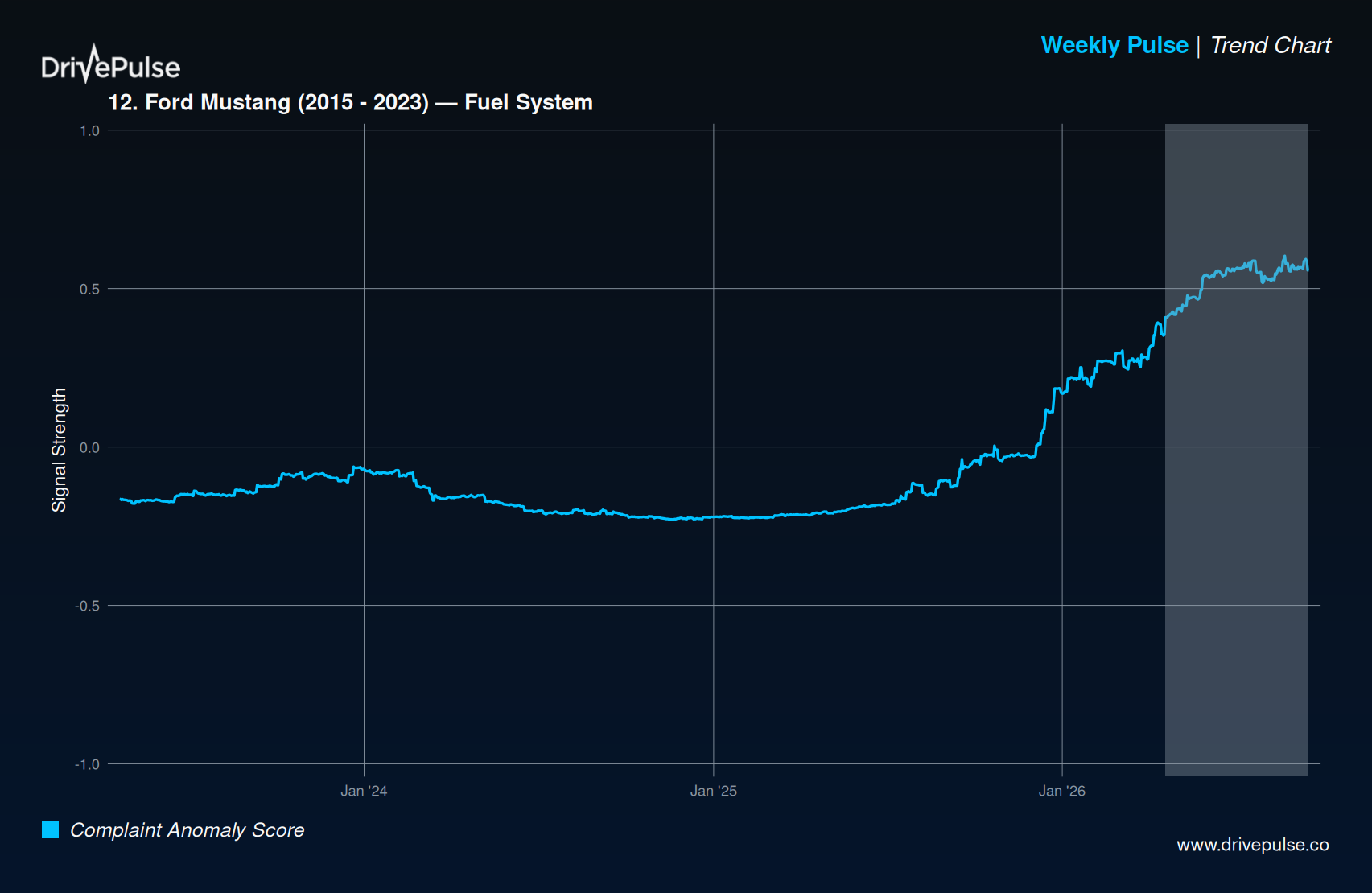
What We're Seeing: EcoBoost owners describe two linked symptoms: engine stumbling or stalling shortly after refueling, attributed to a failing evaporative purge valve, and sudden loss of power or stalling at highway speed, attributed to a low-pressure fuel pump and tracked separately under Recall 25V455/25S75.
In the News: The EcoBoost purge-valve failure is a well-documented, high-frequency part failure discussed extensively in Mustang owner forums and parts-supplier technical guides, though it has not drawn mainstream press coverage as a standalone issue. No press coverage found yet connecting the two symptom clusters described here.
Why It Matters: The purge-valve symptom and the recalled fuel-pump symptom appear together in this complaint cluster despite possibly having distinct root causes, which may be useful for Ford's service organization in distinguishing which repair a given stalling complaint actually needs.
────────────────────────────────────────
Data sourced from NHTSA consumer complaints and automotive forum posts, current through 2026-09-14. Statistical detection by DrivePulse.
DrivePulse | drivepulse.co