
This edition looks at a Colorado brake vacuum pump failure with no prior press coverage, parasitic battery drain on the Crosstrek traced to a module hunting for dead 3G networks, a multi-subsystem cluster on the Altima, and Cybertruck PCS failures that Tesla has now acknowledged with a warranty extension rather than a recall. None of these are safety determinations, statistical anomalies in complaint patterns worth a look from safety and quality teams.
The following represent notable patterns in recent NHTSA complaint data — early signals that may or may not develop into formal recalls. None of the events below constitute a safety determination; they represent statistical anomalies in consumer complaint patterns that warrant attention from safety and quality teams.
────────────────────────────────────────
Affected Model Years: 2021
Complaints: 14 over 68 days
First Detected: 2026-07-03 | Status: New Detection
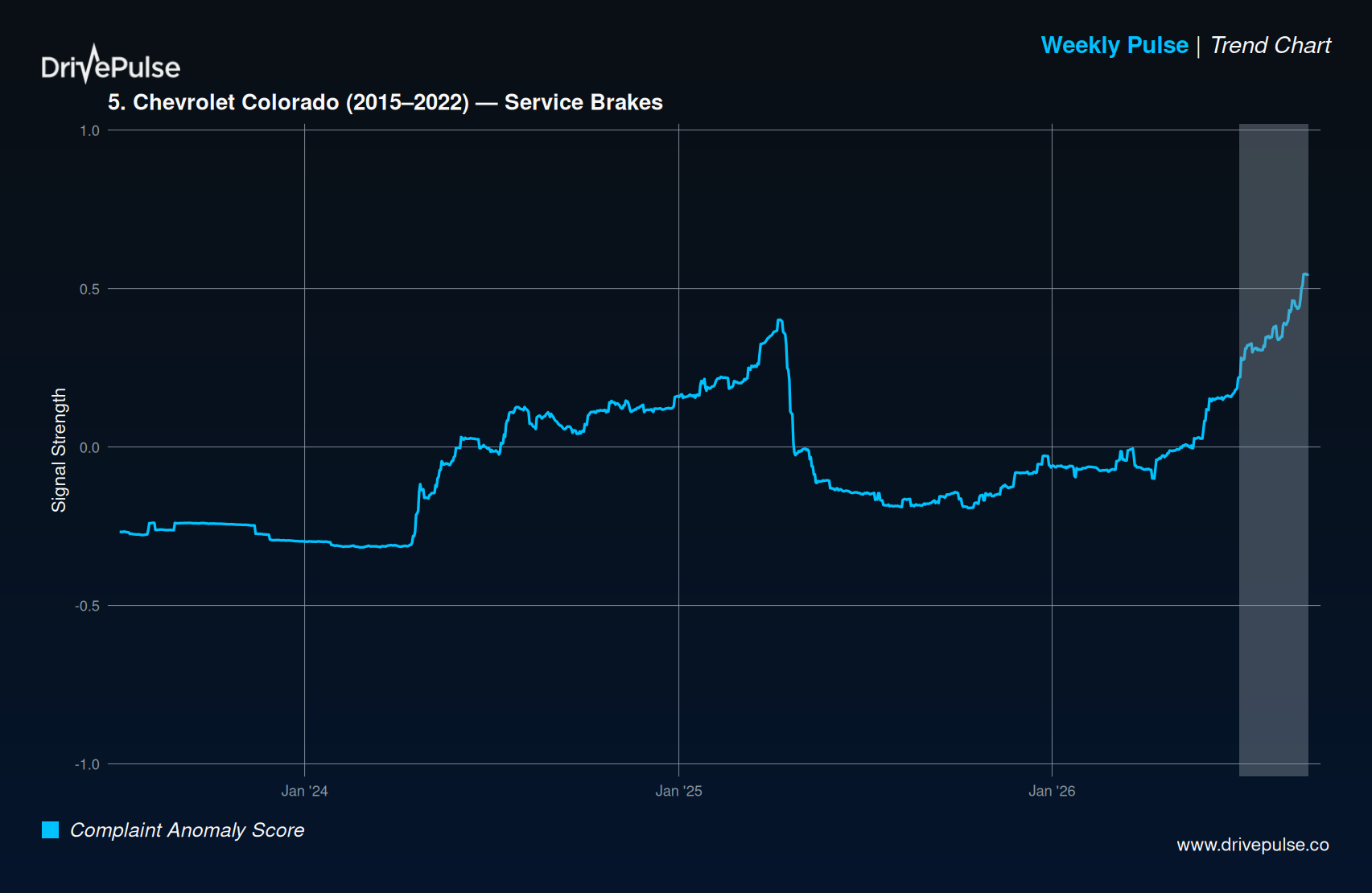
What We're Seeing: Owners describe a vacuum-pump failure that removes power-brake assist, producing a hard pedal, with several reports noting the pump shattering and damaging the camshaft and other engine components. No warning lights precede the failure in most reports.
In the News: GM has faced broader scrutiny over brake vacuum pump reliability across several platforms, including a documented investigation into pumps on full-size trucks and SUVs (Silverado, Sierra, Suburban, Tahoe, Yukon, Escalade) and a separate class action on Equinox/Terrain/Envision brake hardness. No press coverage specific to this Colorado generation's vacuum pump was found; this appears to be an early signal ahead of broader attention.
Why It Matters: A vacuum-pump failure that also causes secondary engine damage is a mechanically distinct failure mode from typical brake wear complaints, which is relevant context for quality teams already reviewing vacuum-pump reliability on other GM platforms.
────────────────────────────────────────
Affected Model Years: 2019
Complaints: 11 over 105 days
First Detected: 2026-05-27 | Status: Active
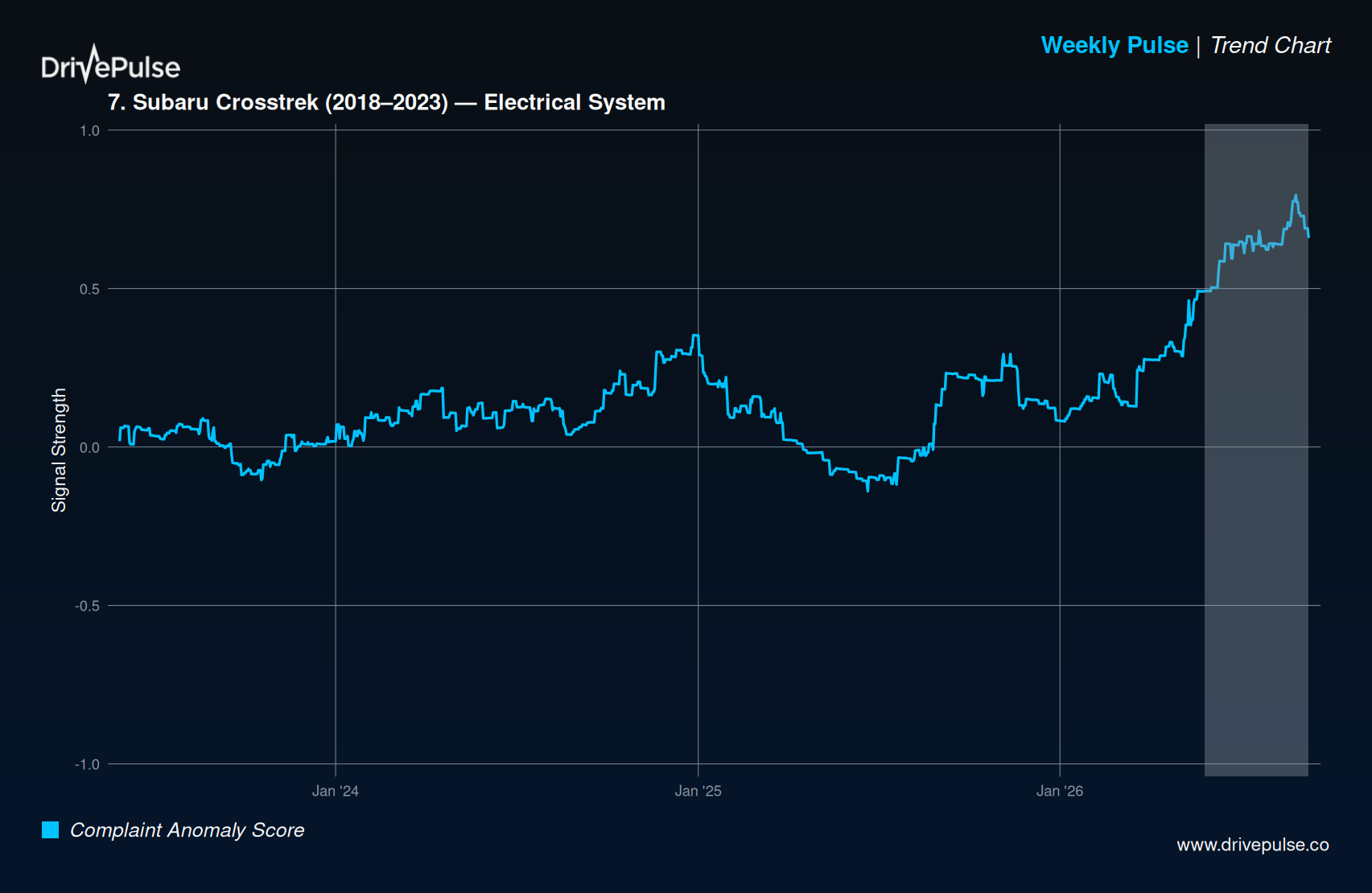
What We're Seeing: The dominant pattern is parasitic battery drain attributed to the data-communications module repeatedly attempting to reach discontinued 3G networks, producing no-start conditions. A secondary set of reports describes ignition-coil and ECM-related stalling.
In the News: Subaru faces a class action covering 2019–2023 Crosstrek and 2019–2024 Crosstrek Hybrid vehicles alleging a defective electrical system with excessive parasitic drain; this event has an active recall link in DrivePulse's records.
Why It Matters: A no-start condition caused by module firmware rather than mechanical wear is a data pattern relevant to quality teams distinguishing hardware defects from software/firmware root causes in connected-vehicle systems.
────────────────────────────────────────
Affected Model Years: 2019, 2020
Complaints: 54 over 115 days
First Detected: 2026-05-17 | Status: Active
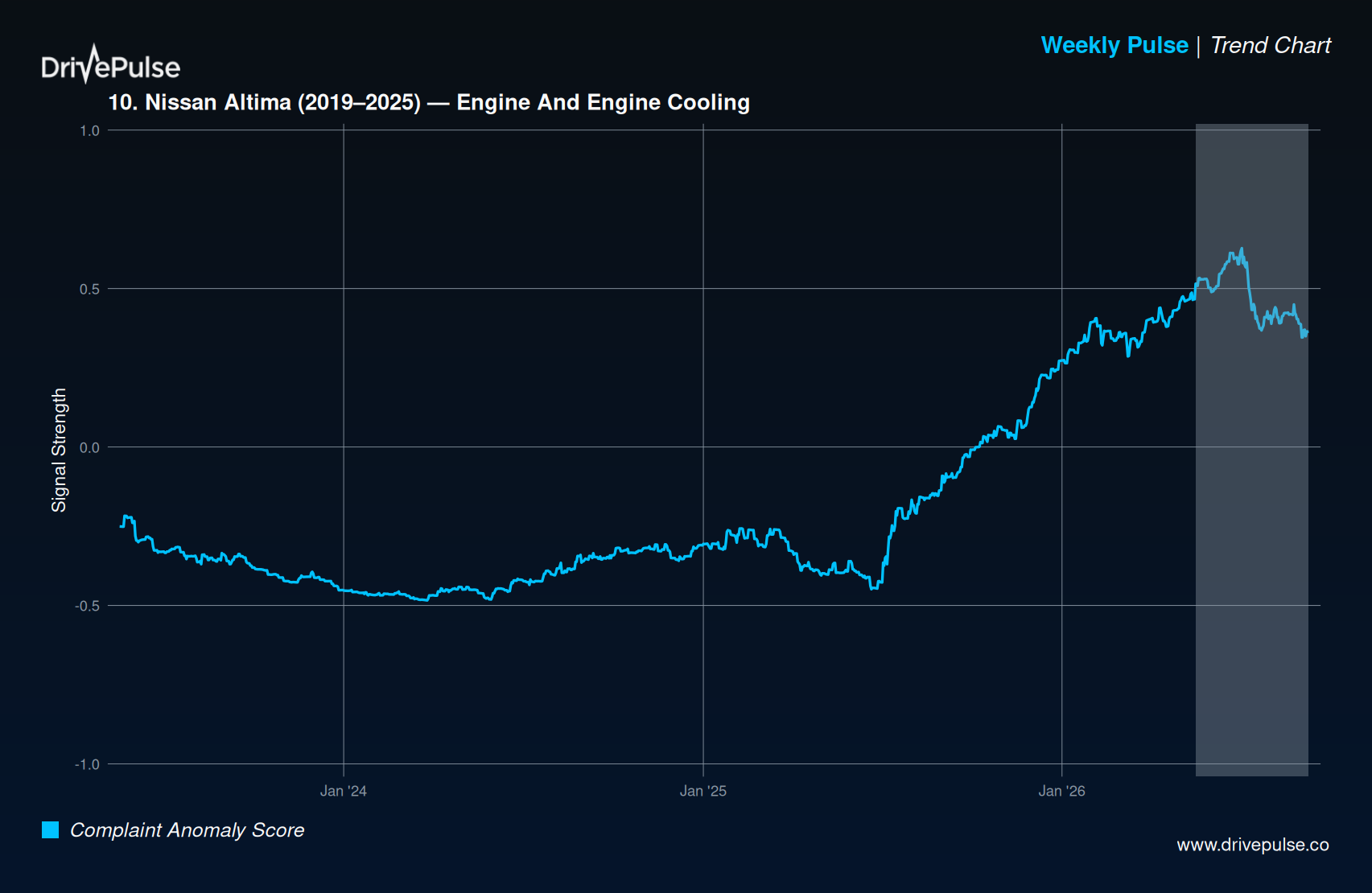
What We're Seeing: Owners report engine-malfunction and power-reduced warnings causing stalling, a CVT that triggers overheating alerts and requires transmission replacement, and overheating/coolant-leak issues linked to head-gasket or thermostat failure.
In the News: Nissan faces a class action alleging 2017–2018 Altima and Sentra vehicles have defective CVTs with inadequate cooling systems; broader CVT litigation against Nissan has generated thousands of NHTSA complaints across model years since 2013.
Why It Matters: A 54-complaint cluster spanning engine, transmission, and cooling subsystems on a high-volume platform is a data point of interest to quality teams already engaged with prior CVT litigation on this nameplate.
────────────────────────────────────────
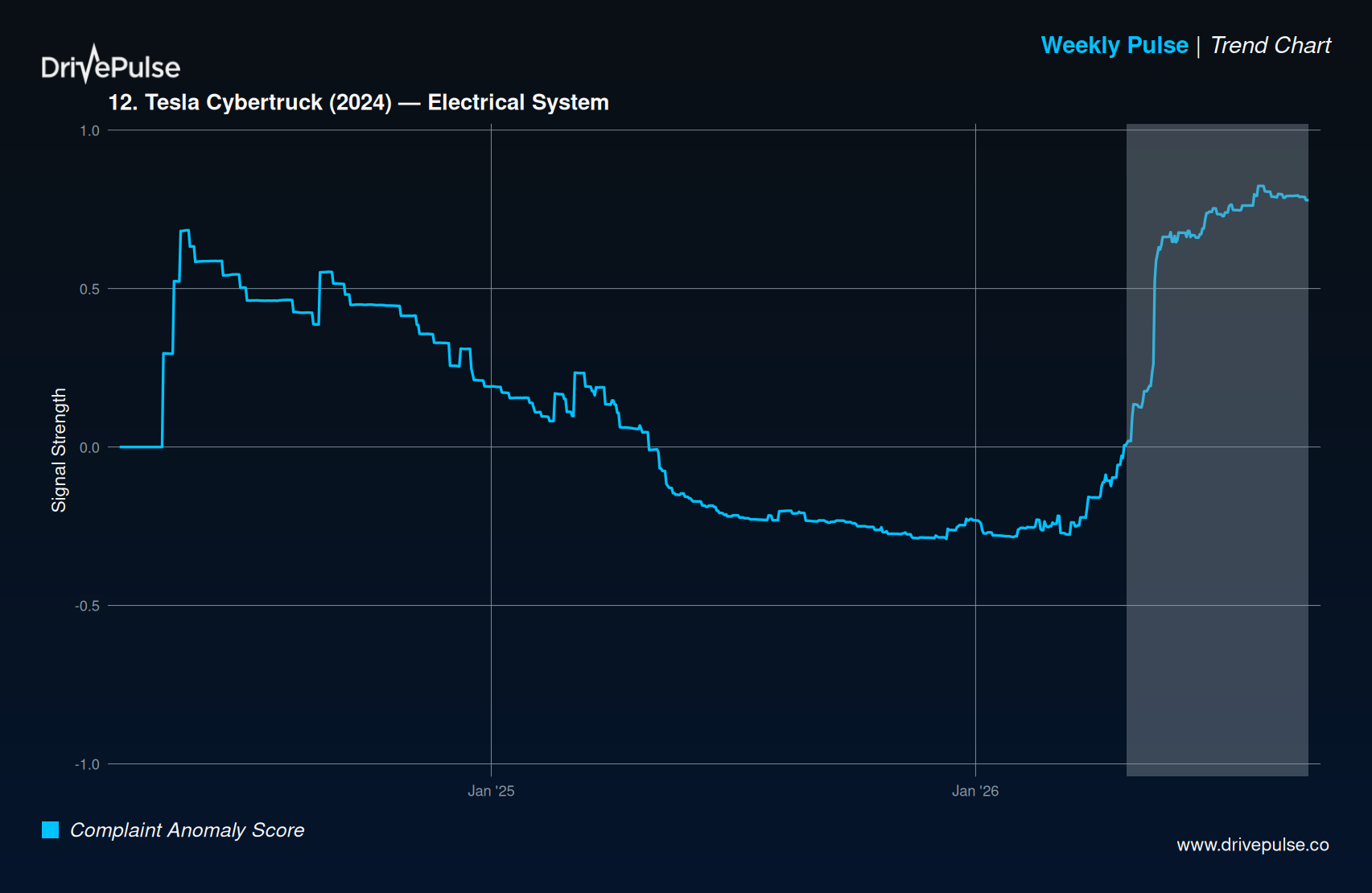
Affected Model Years: 2024
Complaints: 45 over 137 days
First Detected: 2026-04-25 | Status: Active
What We're Seeing: The cluster is dominated by Power Conversion System (PCS) failures — the unit combining the onboard charger and DC-DC converter. Owners report AC charging degrading from 48A to 24A and then failing outright, "AC Charging Unavailable" alerts, and V2L/V2H output errors. Trucks remain drivable and can DC fast-charge, so this reads as a serviceability and stranding-risk defect rather than a crash-risk one. A smaller number of front-end vibration and rear-steer-actuator complaints sit in the same electrical-system bucket but do not drive the cluster.
In the News: On August 7, 2026, Tesla acknowledged the defect and extended PCS coverage on pre-2026 Cybertrucks to 8 years/150,000 miles, with reimbursement for owners who had already paid for replacement. Out-of-warranty repairs had been running $5,000–$7,200 before Tesla began quietly discounting them to about $1,000 as goodwill. No NHTSA recall has been opened on the PCS hardware; the remedy to date is warranty extension plus a software workaround, not a safety recall.
Why It Matters: The PCS integrates the onboard charger with the DC-DC converter that steps the high-voltage pack down to the low-voltage system, so a single part failure spans both charging and vehicle power distribution. Integrated power-electronics modules on new EV architectures are turning up as a recurring early-life failure class. See, for example, Hyundai/Kia's ICCU warranty extension earlier this year.
────────────────────────────────────────
Data sourced from NHTSA consumer complaints and automotive forum posts, current through 2026-09-07. Statistical detection by DrivePulse.
DrivePulse | drivepulse.co