
Five active events in this week's Pulse, spanning brake hydraulics, occupant egress, drivetrain, seating, and ADAS. Two carry no corresponding recall despite outside legal activity already underway. One is a repeat from July that has more than doubled in complaint volume since we last flagged it. A fourth continues to generate complaints more than six years after its remedy campaign closed, which raises a question about remedy effectiveness rather than remedy existence. Ford Fusion · Toyota Tacoma · BMW X7 · Toyota Camry · Honda Clarity
The following represent notable patterns in recent NHTSA complaint data —early signals that may or may not develop into formal recalls. None of the events below constitute a safety determination; they represent statistical anomalies in consumer complaint patterns that warrant attention from safety and quality teams.
────────────────────────────────────────
Affected Model Years: 2010
Complaints: 22 over 65 days
First Detected: 2026-06-22 | Status: Active
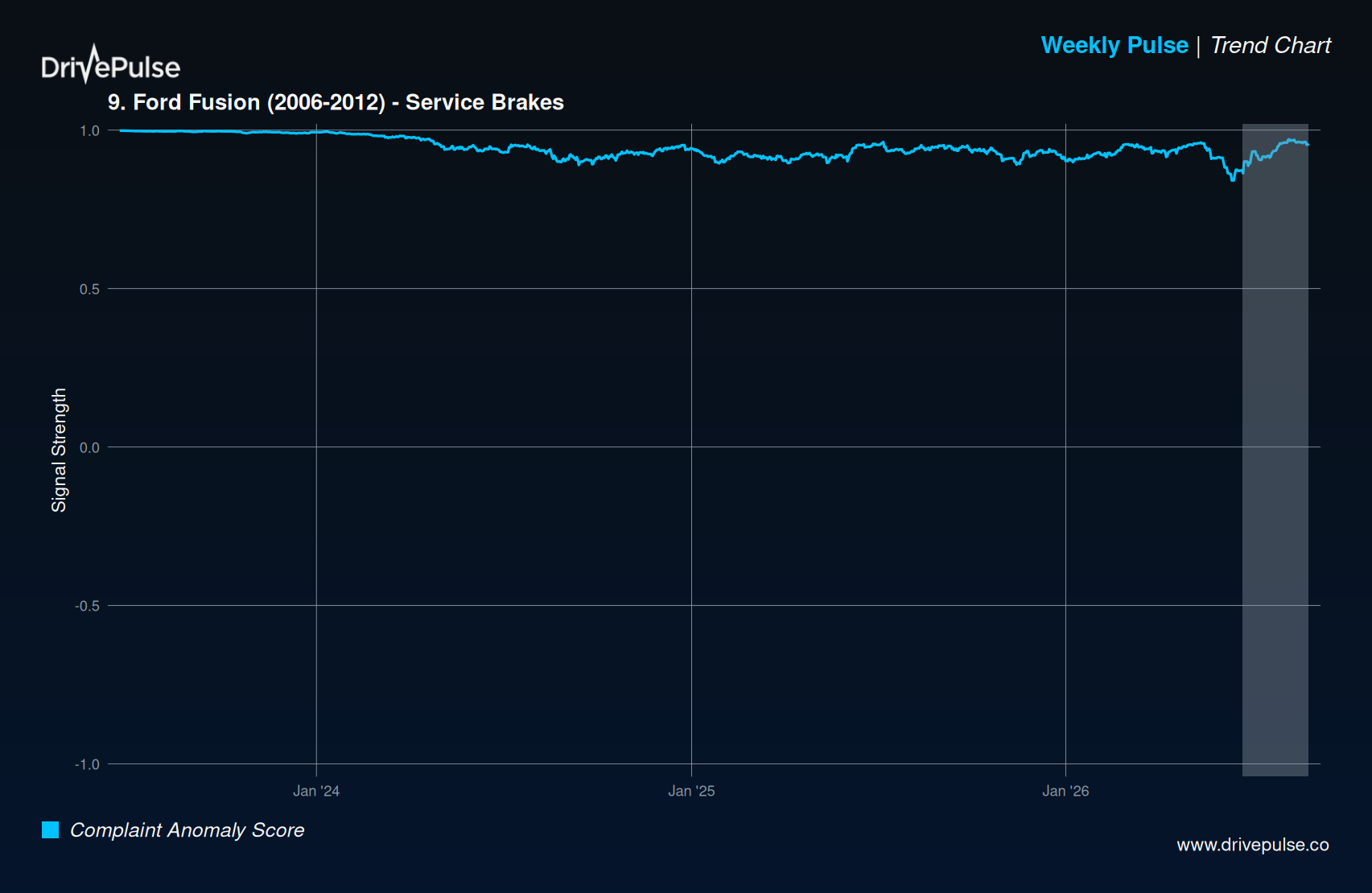
What We're Seeing: Owners describe the brake pedal dropping toward the floor accompanied by ABS and traction-control warning lights, consistent with the ABS Hydraulic Control Unit (HCU) valve defect covered under an existing recall; a smaller number of complaints also describe power-steering assist loss occurring alongside the braking symptoms. This event is linked to an existing recall and NHTSA has an open investigation.
In the News: Ford recalled certain 2006-2010 Fusion, Mercury Milan, Lincoln Zephyr, and MKZ vehicles in December 2019 (campaign 19V904000) after finding that HCU valves could react with certain brake-fluid corrosion-preventative additives and fail to close properly; NHTSA's investigation file for the underlying issue recorded 15 accidents and 2 injuries across the affected population. NHTSA opened a further investigation (DP26004) in April 2026 into ABS malfunction-indicator-lamp illumination in this population.
Why It Matters: This is a defect already tied to documented crashes and injuries in NHTSA's investigation record, and continued complaint volume more than six years after the recall's owner-notification period is a relevant data point for safety teams assessing remedy completion and effectiveness on this platform.
────────────────────────────────────────
Affected Model Years: 2025
Complaints: 28 over 70 days
First Detected: 2026-06-17 | Status: Active
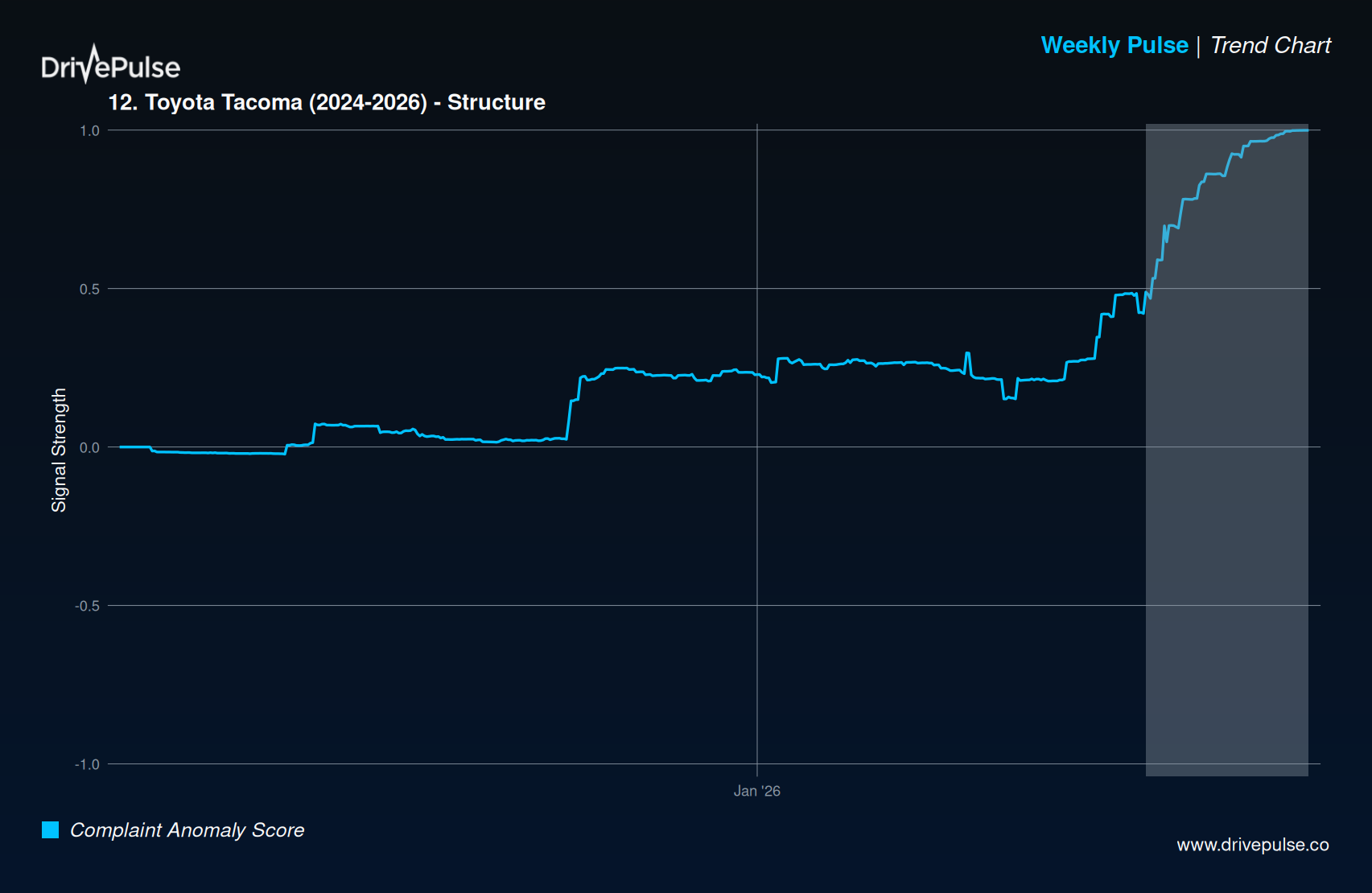
What We're Seeing: Owners of 2024-2025 Tacoma trucks report interior door handles breaking or disconnecting during normal use at low mileage, preventing the door from being opened from inside the cabin; several complaints describe replacement parts as being on long-term national backorder.
In the News: We found no formal NHTSA recall for this specific defect at this time; owner forums and at least one reported denied warranty claim (Toyota citing "excessive force" on a 2025 model) document the pattern, and dealers report large numbers of units awaiting parts.
Why It Matters: This event was previously featured in DrivePulse's July 13, 2026 post at 13 complaints; complaint volume has more than doubled since then, which is the kind of escalation this filter is designed to surface — an interior door mechanism that fails to open is a data point of particular interest to safety teams given its bearing on occupant egress.
────────────────────────────────────────
Affected Model Years: 2020, 2021
Complaints: 18 over 73 days
First Detected: 2026-06-14 | Status: Active
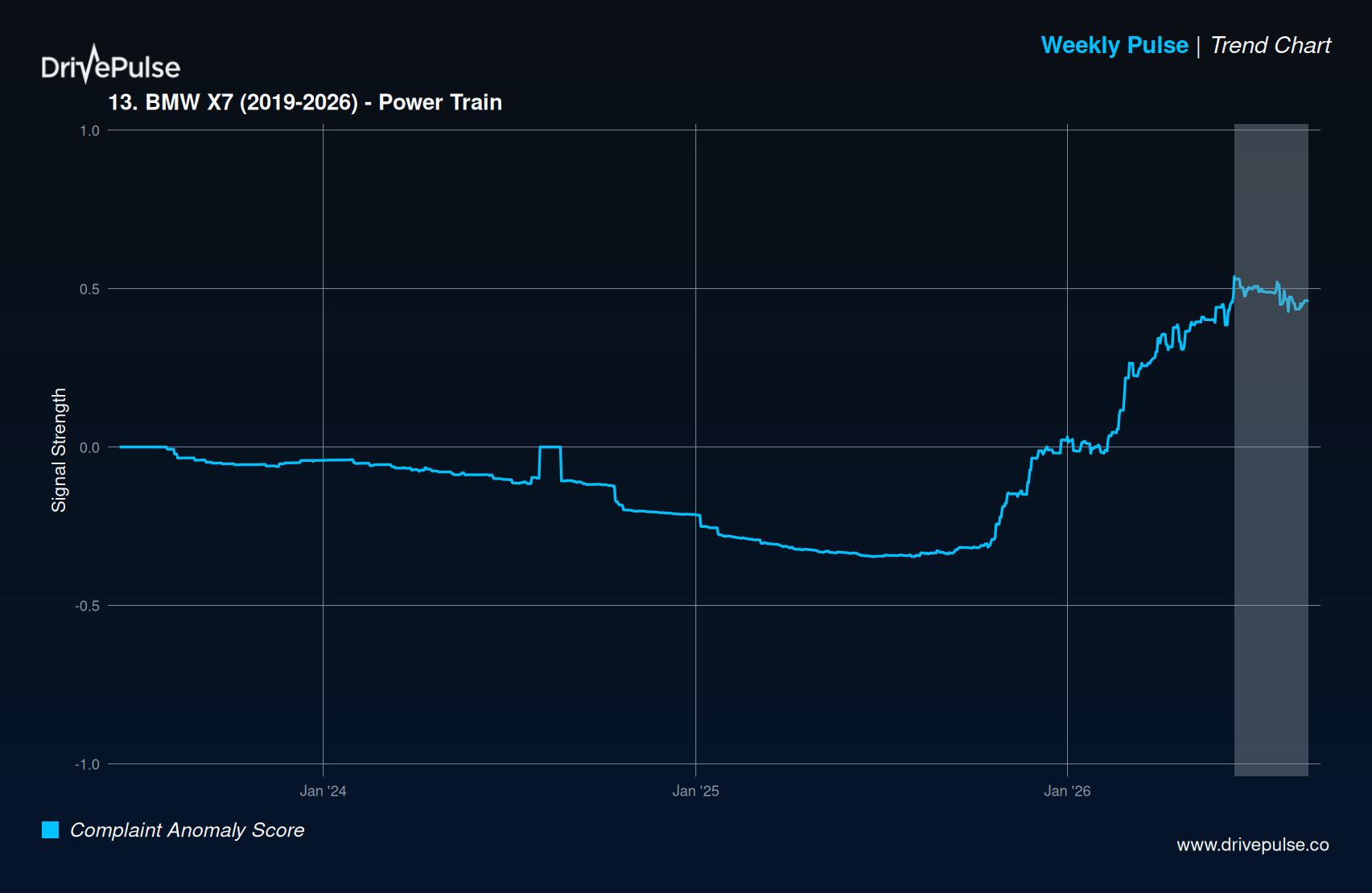
What We're Seeing: Owners describe two related drivetrain failure modes: a transfer case that shudders or briefly disengages at low speed, and front-differential failures under 60,000 miles that owners describe as sudden and, in some cases, accompanied by physical damage to the differential housing.
In the News: We found no formal NHTSA recall specific to this defect; Kalfayan Law Firm has published investigative material describing a potential transfer-case defect across the X3, X4, X5, and X7 lines, and owner forums document repeated reports of the same failure pattern.
Why It Matters: A sudden, unannounced loss of drivetrain function at speed is relevant to safety teams regardless of recall status, and the absence of a current recall despite an active outside legal investigation is itself a useful data point for OEM quality teams monitoring pre-recall signal strength.
────────────────────────────────────────
Affected Model Years: 2025, 2026
Complaints: 31 over 80 days
First Detected: 2026-06-07 | Status: Active
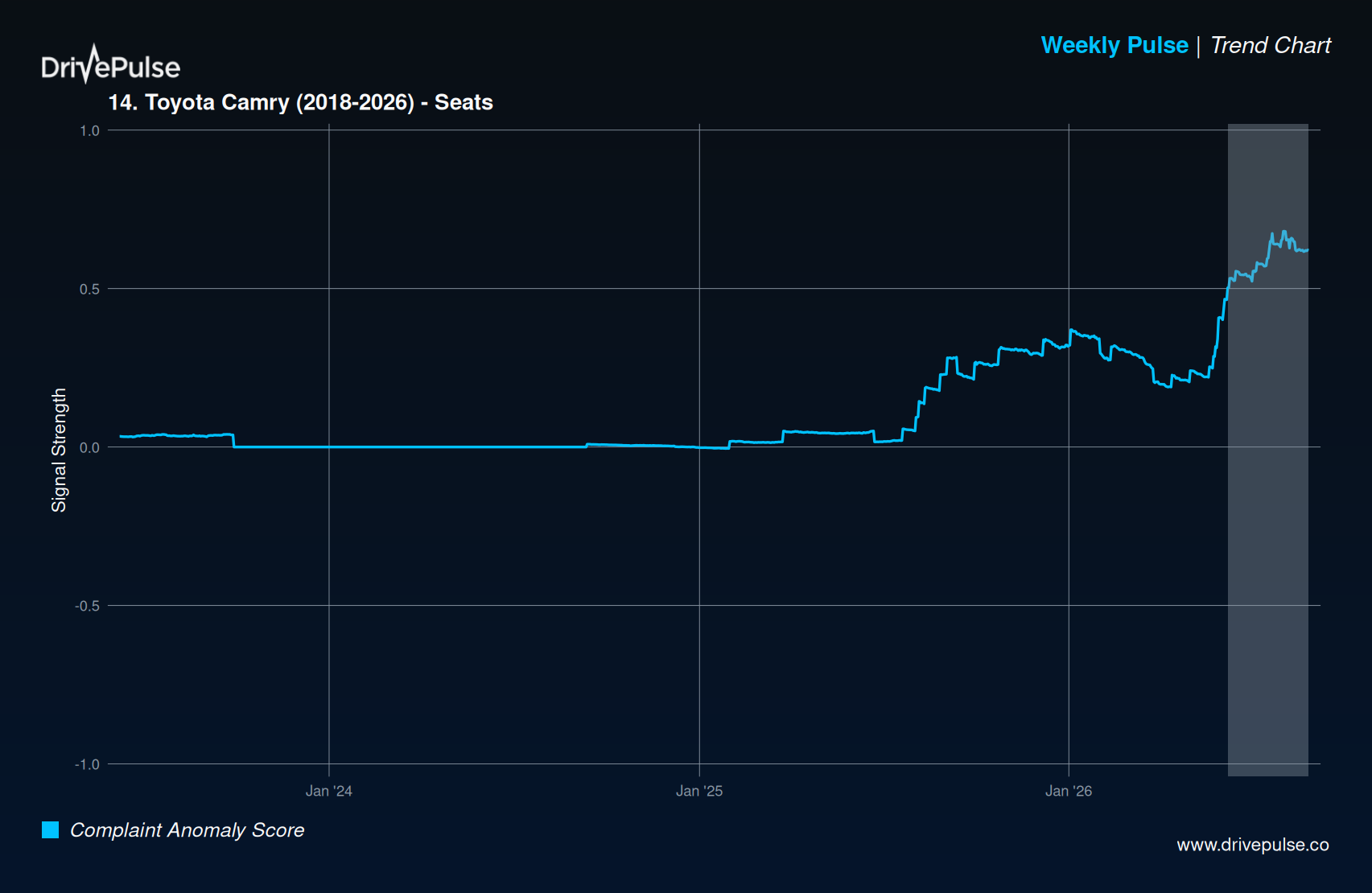
What We're Seeing: Owners of 2025-2026 Camry vehicles describe the driver seat's lumbar support and back-rest assembly popping, shifting, or failing to lock fully during normal driving, along with isolated reports of insufficient seat-back cushioning. This complaint pattern is distinct from Toyota's existing head-restraint welding recall on this platform.
In the News: Toyota recalled certain 2023-2024 Camry and Camry Hybrid vehicles in February 2024 (campaign 24V128000) for insufficiently welded second-row head-restraint brackets — a different seat defect, in a different row, from the front driver-seat lumbar issue described in this week's complaints. A law firm has opened an active investigation into the newer seat-popping pattern.
Why It Matters: Because this event's component category (Seats) has separately been the subject of serious injury litigation for other Toyota model years involving a different failure mode (rear-crash seatback collapse), we want to be precise: nothing in this week's complaint data links the current lumbar-support issue to that unrelated, older litigation, and we found no fatality or injury reports tied specifically to this defect.
────────────────────────────────────────
Affected Model Years: 2018, 2020
Complaints: 10 over 157 days
First Detected: 2026-03-22 | Status: Active
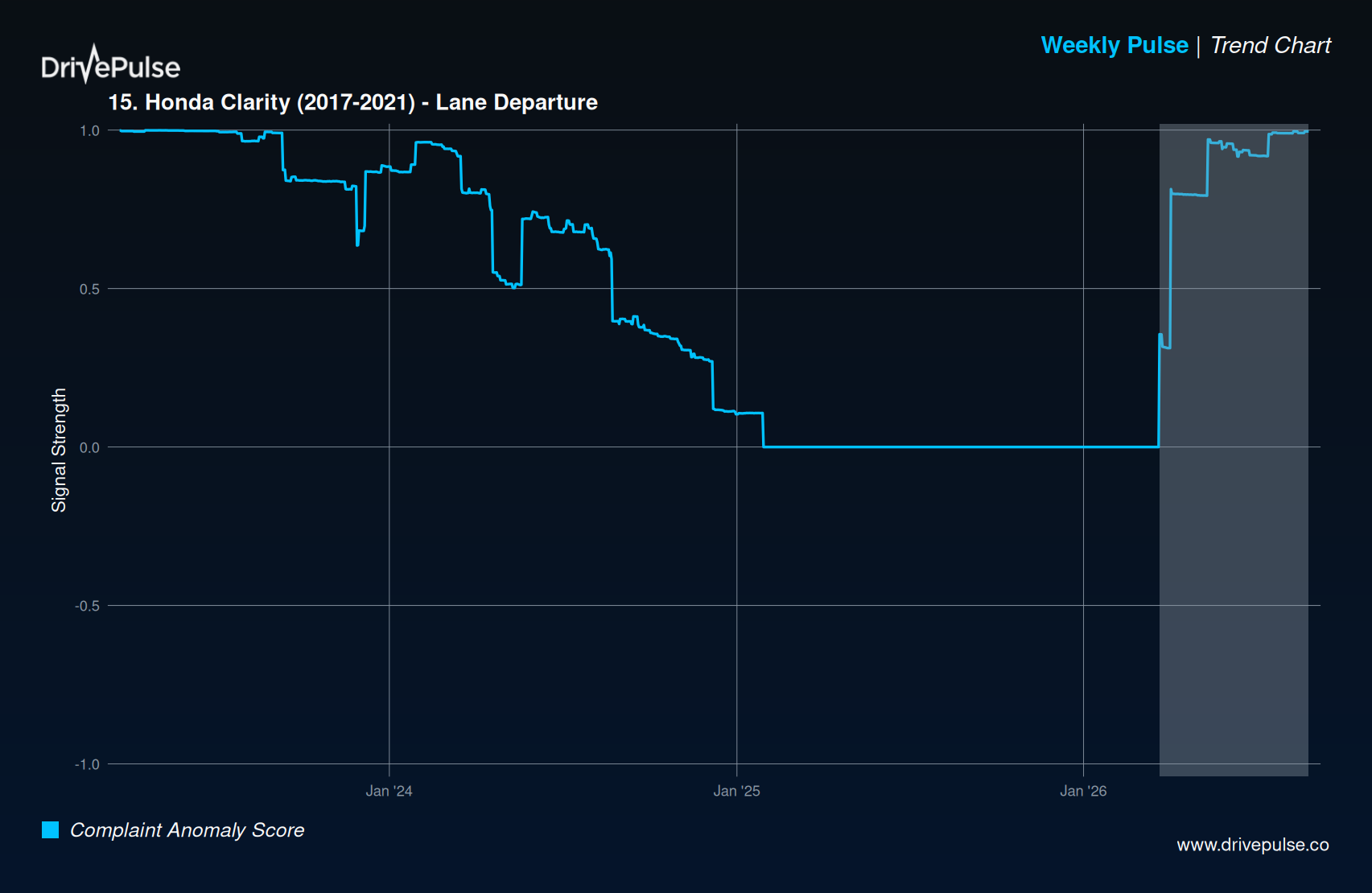
What We're Seeing: Owners report a forward-mounted ADAS camera failing intermittently or permanently, which disables Lane Keeping Assist, Collision Mitigation Braking, Adaptive Cruise Control, and Road Departure Mitigation simultaneously and triggers a persistent "Honda Sensing Problem" dashboard message; the pipeline associates the failure with a documented hardware fault code (U3000-49).
In the News: The Clarity is named among the vehicles covered by an active class-action lawsuit alleging a front-camera defect across several Honda models; we found no NHTSA recall specific to the Clarity for this issue, and no fatality or injury reports tied specifically to the Clarity's camera failure, though broader Honda Sensing camera complaints across the company's lineup include unspecified crash and injury reports not attributable to this platform.
Why It Matters: A single camera fault disabling four independent driver-assist systems at once is a concentration-of-failure pattern relevant to safety teams evaluating single-point-of-failure risk in ADAS architecture, independent of this event's current recall status.
────────────────────────────────────────
Data sourced from NHTSA consumer complaints and automotive forum posts, current through August 24, 2026. Statistical detection by DrivePulse.
DrivePulse | drivepulse.co