
Recalls are announced years — sometimes decades — after the first warning signs appeared. DrivePulse is building the missing signal: a continuous monitoring system that detects emerging vehicle defects before they reach the scale that triggers a formal investigation.
Every modern car has a check engine light. When something goes wrong, a sensor fires, a code gets logged, and a warning appears on your dashboard. The system isn't perfect, but it's better than nothing — it surfaces a problem before it becomes a catastrophe.
The automotive industry doesn't have an equivalent. Defects emerge gradually, complaints trickle in across thousands of vehicles, and by the time anyone notices a pattern, the damage is done. Recalls are announced years — sometimes decades — after the first warning signs appeared.
DrivePulse is building that missing signal.
We monitor consumer complaints filed with the NHTSA and discussions in online automotive forums, continuously and across the full U.S. vehicle fleet. When complaint activity for a specific make, model, and component starts to deviate meaningfully from historical norms, our system flags it as an emerging safety event — before it reaches the scale that triggers a formal investigation or recall.
We're not counting complaints. We're detecting sustained, statistically abnormal patterns. A popular vehicle like the Honda Accord will always generate more raw complaints than a Land Rover Discovery — that's just fleet size. What matters is whether complaints are rising faster than they should, relative to baseline. That's the signal we're after.
At the core of DrivePulse is an indicator that measures how much complaints about vehicle-component combinations deviate from historical norms, scaled to account for fleet size and complaint volume. We run event detection over 180-day windows, flagging events only when the deviation from normal is both significant and sustained — not a one-week spike, but a persistent shift in complaint behavior. Detected events are then summarized automatically into plain-language descriptions of the underlying issue.
The result is a continuously updated database of active safety events across makes, models, and components — currently drawing on over 2 million NHTSA complaint records spanning three decades, supplemented by forum data.
We've tested our system against three known recalls — two where complaint-based signals preceded regulatory action by years, and one instructive case where they didn't. These case studies are a starting point. Rigorous evaluation requires expert judgment to code detections against ground truth — not all defects generate complaint signals, and not all defects become recalls. We're building toward that; the signal, in the meantime, is real.
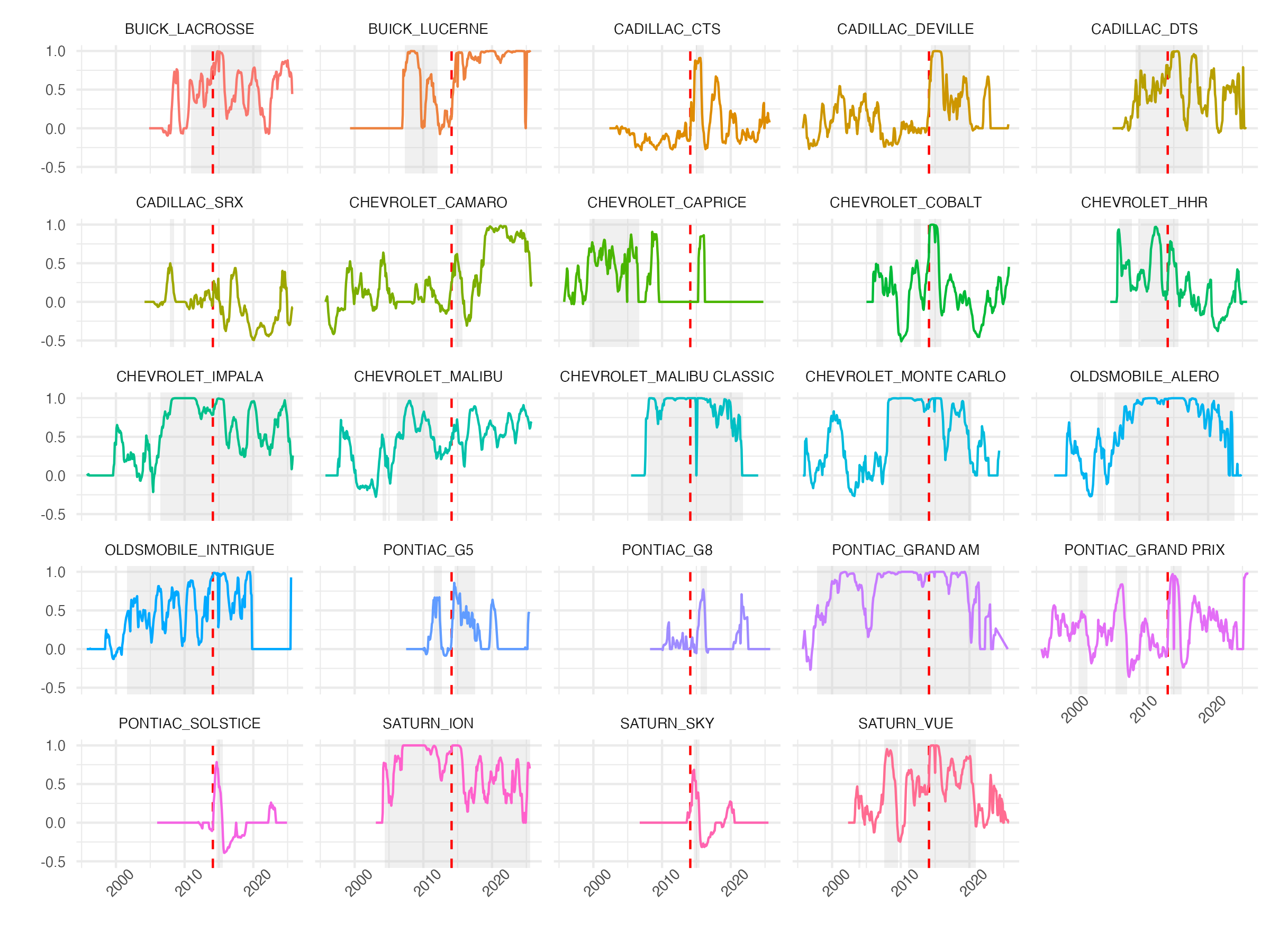
Beginning in the early 2000s, owners of several GM models began filing complaints describing unexpected engine shutoff and airbag non-deployment. The complaints accumulated for years before GM announced a recall of approximately 30 million vehicles in February 2014.
DrivePulse detected pre-recall events for 19 of the 24 ultimately recalled models — 79% — with a mean lead time of 7.43 years before the recall. 62% of those detections occurred in the 2001–2007 window.
Between the mid-2000s and 2010, Toyota and Lexus owners filed a growing volume of complaints describing sudden, unintended acceleration across a range of models. Nine separate recalls eventually covered approximately 10.5 million vehicles.
DrivePulse detected pre-recall events for 15 of the 24 affected models — 63% — with a mean lead time of 4.2 years before regulatory action.
Starting around 2015, Hyundai and Kia owners began reporting engine failures, oil leaks, and in some cases fires across vehicles equipped with the Theta II engine. More than 2.4 million vehicles were eventually recalled.
Here, our system found few pre-recall detections — and none describing the root cause. This case taught us something important about the boundaries of complaint-based detection: manufacturing defects present at origin generate almost no consumer complaint signal before vehicles begin failing in the field. Our method detects defects that develop and accumulate over time. Silent failures at the point of manufacture are outside that window. We include this case because knowing where a system doesn't work is as important as knowing where it does.
By the time a problem is obvious, it's already old news.
We'll be posting regularly on what our system is detecting across the U.S. vehicle fleet — emerging patterns, component trends, and the occasional case study as we build them. If you want early access to what we're seeing before it's public, we're currently selecting a small number of design partners for pilot engagements. Reach out at info@drivepulse.co.